You’ve been wiped out for ten days. Your throat feels like sandpaper, and a friend just said the word “mono.” Now you want one answer: how long does mono last?
Most people feel better in 2 to 4 weeks. The tiredness is the stubborn part. It can hang around for 2 to 3 months, and now and then even longer. That’s the short version. The rest of this guide covers the full timeline, how long you’re contagious, when school and sports are back on the table, and the warning signs that mean it’s time to stop waiting and get seen.
How long does mono last?
Mononucleosis is an infection, usually caused by the Epstein-Barr virus (EBV), and it runs on a slow clock. The CDC says mono symptoms typically show up 4 to 6 weeks after infection. Mayo Clinic gives a slightly wider window of 4 to 7 weeks. So by the time you feel sick, you picked up the virus a month or more ago. Catching EBV doesn’t guarantee illness, either. The CDC says at least 1 in 4 teenagers and young adults infected with EBV go on to develop mono.
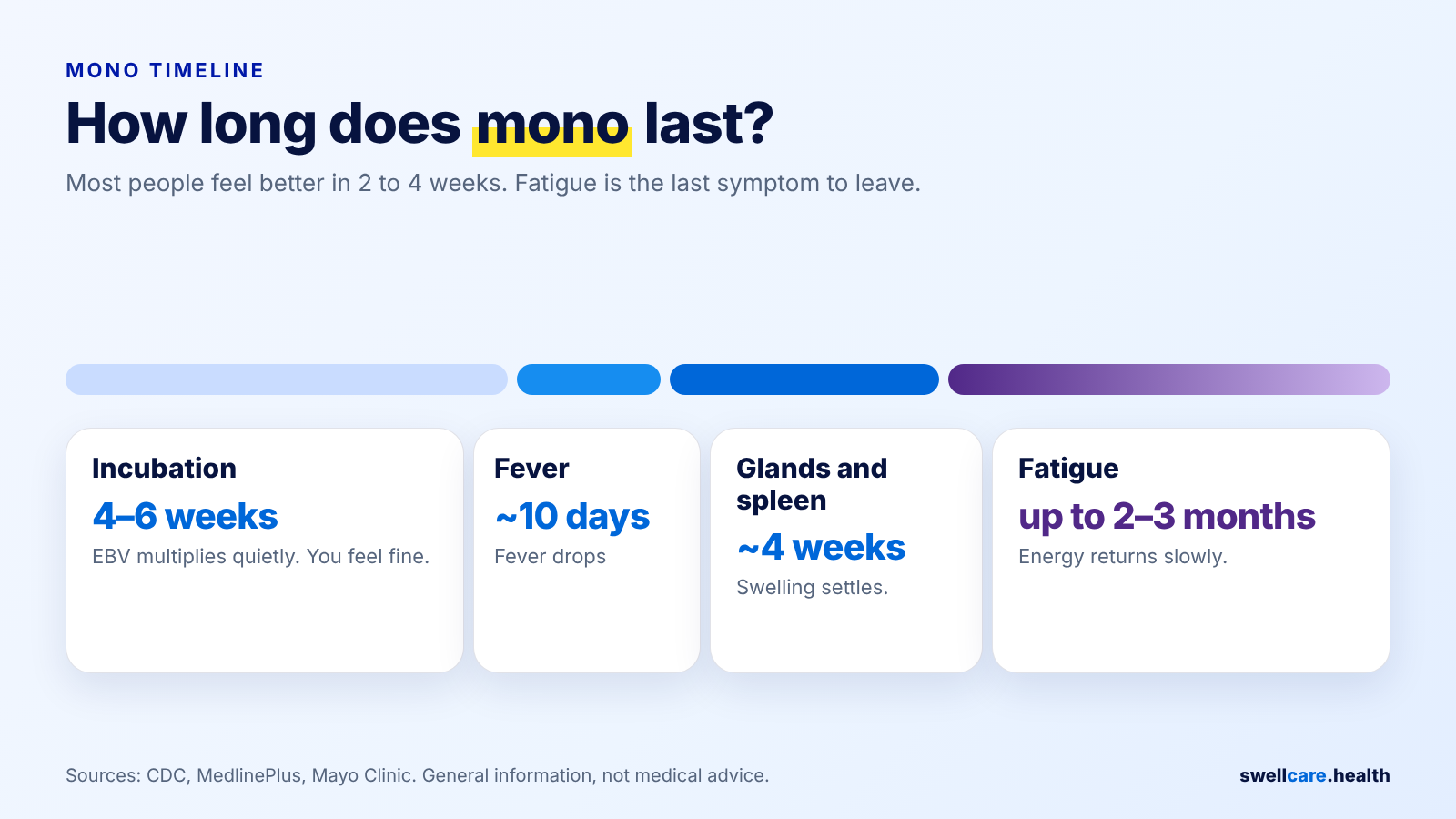
Once symptoms start, the mono timeline looks roughly like this, based on MedlinePlus:
| Phase | How long it lasts | What’s happening |
|---|---|---|
| Incubation | 4 to 6 weeks | EBV multiplies quietly. You feel fine. |
| Fever and sore throat | Fever drops in about 10 days | The worst stretch. Swallowing hurts. |
| Swollen glands and spleen | About 4 weeks to settle | Lymph nodes shrink first. The spleen takes longer. |
| Fatigue | Several weeks, up to 2 to 3 months | Energy returns slowly, then all at once. |
Nearly everyone with mononucleosis recovers fully. A small number of people feel off for six months or longer, according to the CDC, so a slow recovery doesn’t automatically mean something’s wrong.
Why the fatigue lingers after the fever is gone
Your immune system just fought a long battle with the Epstein-Barr virus. The sore throat fades first. Energy comes back last, and fatigue is the symptom that outlasts all the others. Age matters too. Mayo Clinic notes that the older you are when you get mono, the more likely your symptoms are to be worse and last longer.
Mono symptoms and what to expect
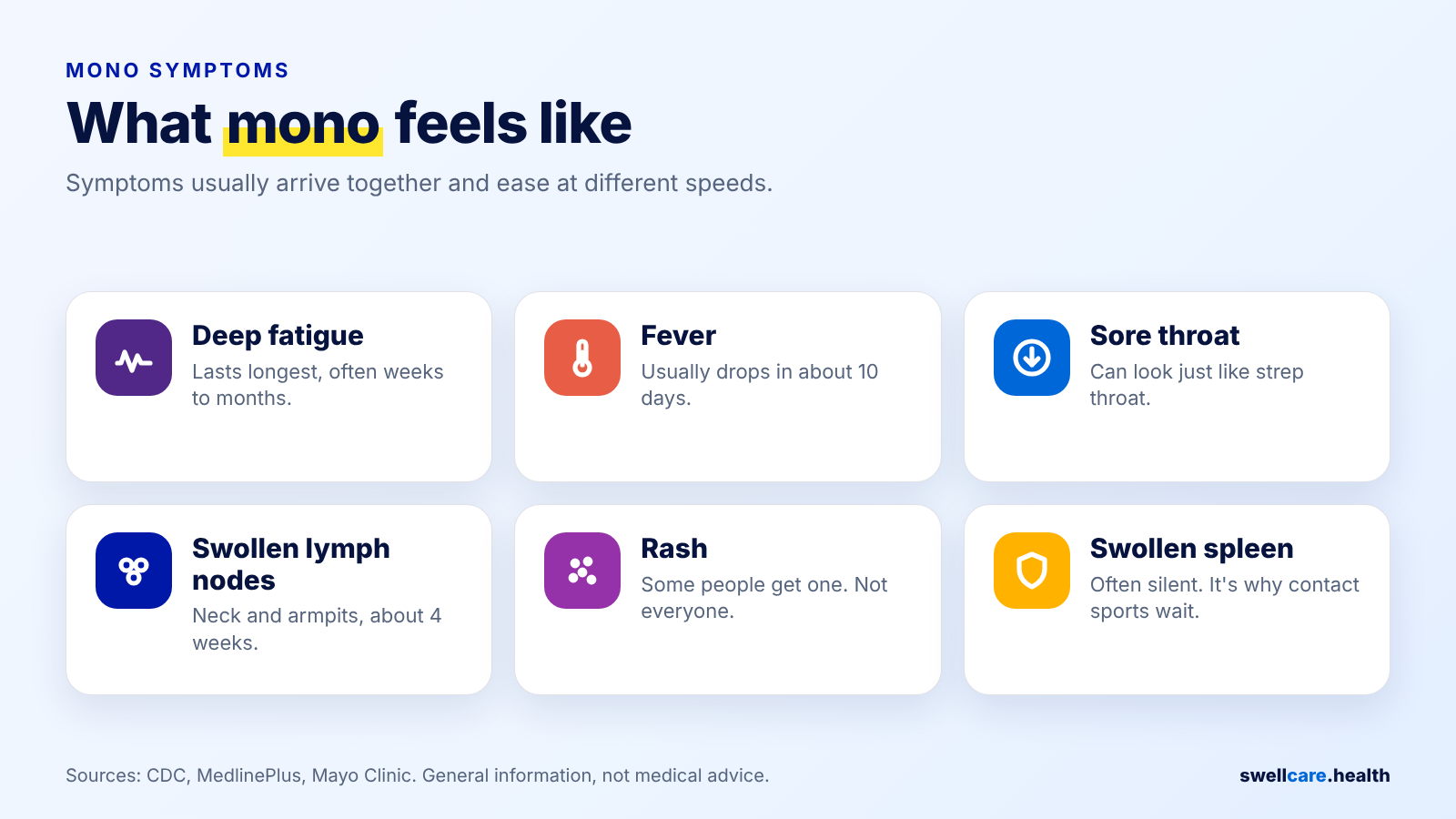
The classic symptoms of mononucleosis tend to arrive as a pack. You’ll likely have deep fatigue, a fever, a sore throat that can look just like strep throat, and swollen lymph nodes in your neck or armpits. Headaches and body aches are common. Some people break out in a rash. Others have a swollen spleen and never feel it.
Early on, the symptoms can feel like a bad flu that refuses to leave. A week later, the sore throat gets worse before it gets better, and the fatigue can feel out of proportion to everything else.
How long are you contagious with mono?
This is where mono gets awkward. MedlinePlus says you can spread it while you have symptoms and for up to a few months afterward. Mayo Clinic adds that the virus can live in your saliva for months after infection. So the contagious period outlasts the illness itself.
EBV travels in saliva. Kissing is the famous route, but sharing a cup, a fork, a water bottle or a toothbrush counts too. The CDC also lists blood and semen, plus blood transfusions and organ transplants. Mayo points out that mono doesn’t spread as easily as the common cold.
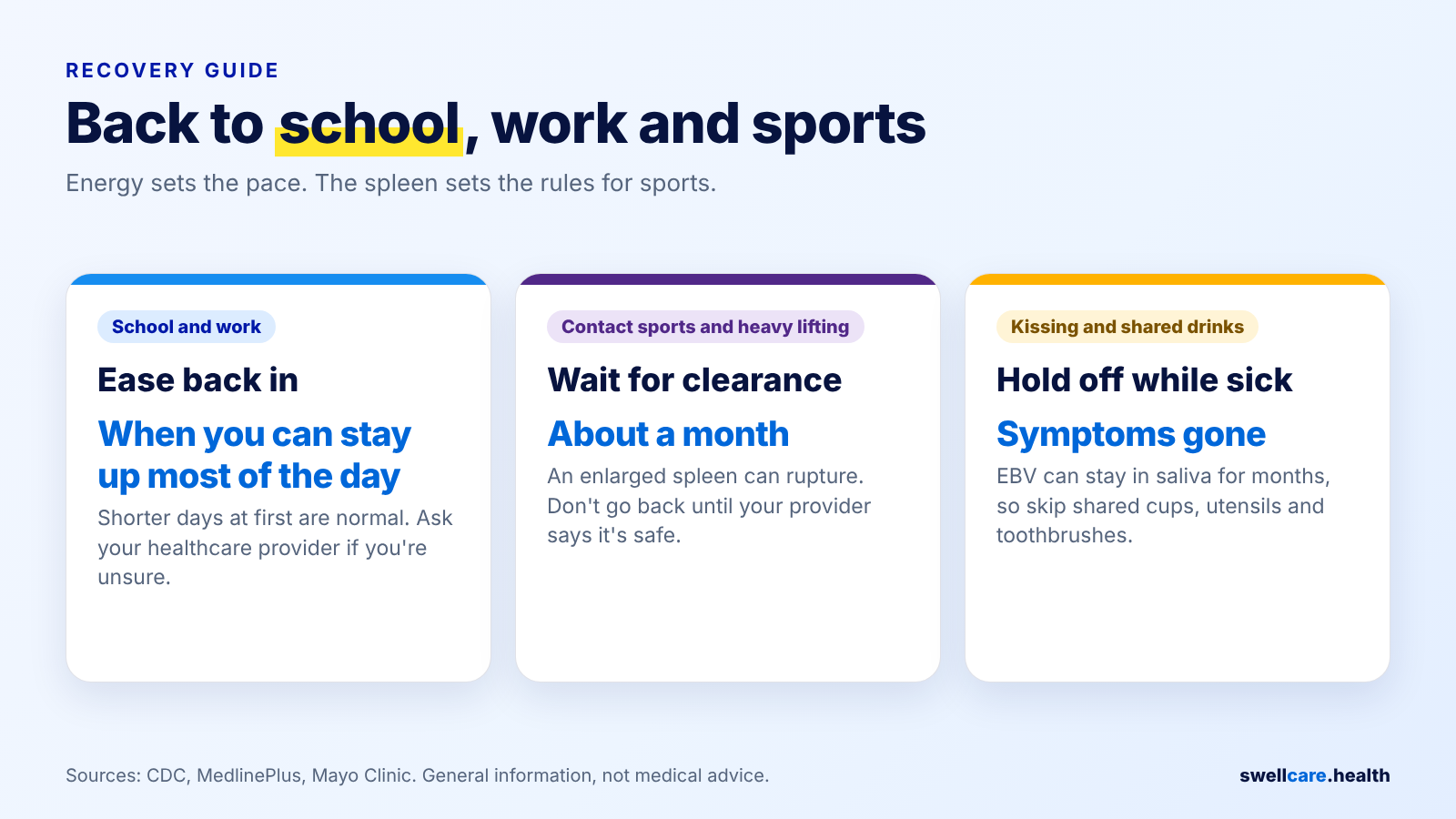
You don’t have to hide at home for months. Skip shared drinks, utensils and toothbrushes, and hold off on kissing while you’re sick. That covers most of the risk.
When can you go back to school, work or sports?
Return to school or work mostly comes down to energy. Many people ease back in once the worst symptoms have passed and they can stay upright for most of the day, often with shorter days at first. Your healthcare provider can give you a clear go-ahead if you’re unsure.
Sports are a different story.
Mononucleosis can enlarge your spleen, and a hard hit can make it rupture. A spleen rupture causes heavy bleeding and is a medical emergency. Mayo Clinic says a healthcare provider may suggest waiting about a month before heavy lifting or contact sports. The CDC says to avoid contact sports until you’ve fully recovered. This matters most for teenagers on school teams, who are often the most eager to get back. Ask your healthcare provider before you suit up.
Going back too fast has another cost. Mayo notes that returning to normal activity too soon can raise the risk of a relapse, so talk to your healthcare provider about a pace that fits your recovery.
What helps you recover faster
No medicine cures mono. Treatment for mononucleosis is about comfort while your immune system clears the infection. Here’s what actually helps:
- Rest. It’s the closest thing to a real treatment. Sleep when you’re tired, even if that means three naps.
- Fluids. Water and juice keep dehydration away, which matters when swallowing hurts.
- Pain relief. Acetaminophen or ibuprofen can ease headache and throat pain. Don’t give aspirin to children or teenagers.
- A salt-water gargle. Mayo suggests a quarter teaspoon of salt in 8 ounces of warm water.
Antibiotics don’t work on a virus. They’re only useful if you also have a bacterial infection like strep.
Why amoxicillin can cause a rash with mono
Plenty of people get handed amoxicillin for a sore throat before anyone thinks of mono. The CDC says people with mono shouldn’t take penicillin antibiotics such as ampicillin or amoxicillin, and Mayo says they can trigger a rash. If you’ve already started one and a rash appears, call your doctor.
Is it mono, strep or something else?
Strep throat, flu and mononucleosis overlap a lot. The difference matters because antibiotics help strep and do nothing for mono. A quick throat swab can rule strep in or out.
Your doctor will usually start with your symptoms and an exam of your lymph nodes, tonsils and belly. The CDC says labs usually aren’t needed unless a case looks unusual. If a test is ordered, it’s often a Monospot test or an antibody test. Mayo notes that antibody tests can miss an infection in the first week, so a negative result early on isn’t always final.
When to see a doctor or go to the ER
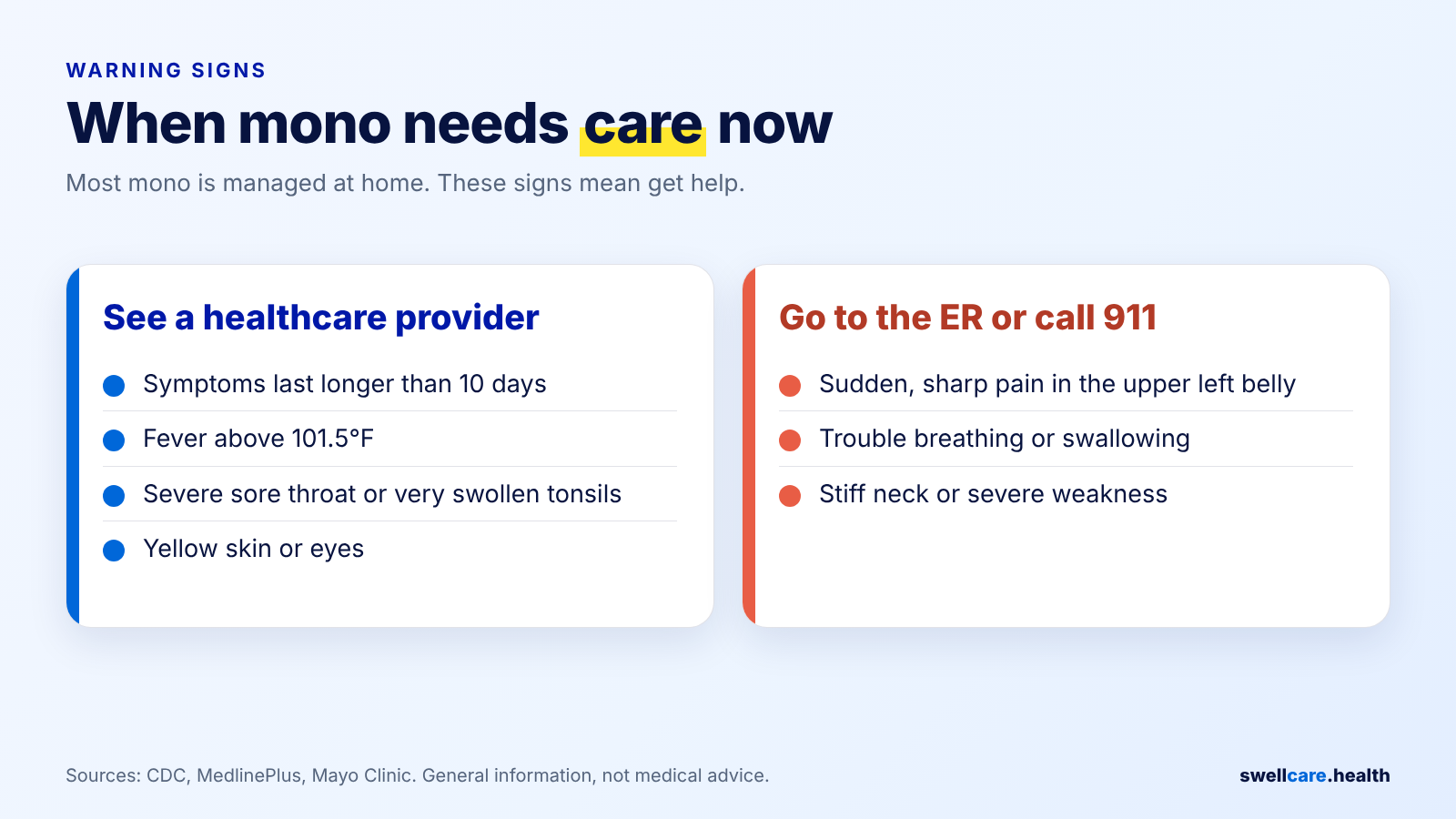
Book a visit with a healthcare provider if your symptoms last longer than 10 days, or if they haven’t improved after a week or two. Also call if you have a fever above 101.5°F, a severe sore throat, very swollen tonsils, or yellow skin or eyes.
Go to the ER or call 911 for any of these:
- Sudden, sharp pain in the upper left side of your belly, which can signal a spleen rupture
- Trouble swallowing or breathing
- A stiff neck or severe weakness
Get mono questions answered with Swell
Not sure whether you’re dealing with mono, strep, flu or something else? Start with a conversation. At Swell, a licensed clinician reviews what’s going on, explains what can be handled online and tells you what to do next. Confirming mono can take an in-person exam with a doctor or lab work, and we’ll tell you plainly if that’s the right step instead of guessing.
Questions people ask about mono
Does mono go away untreated?
Yes, in most cases. There’s no specific treatment for the virus, and nearly everyone recovers fully with time and rest. Symptoms fade as your body clears the virus. Care focuses on comfort and on protecting your spleen. If symptoms drag past 10 days or get worse, see a doctor.
What are the four stages of mono?
There’s no official staging system, but it helps to picture four phases: incubation (4 to 6 weeks with no symptoms), onset (the first symptoms: fatigue and a sore throat), peak (swollen glands, worst throat pain) and recovery (fatigue slowly lifting over weeks).
Can I never kiss again after mono?
Of course you can. Wait until your symptoms are gone, and know that EBV can stay in your saliva for months. Most adults have already been exposed to the Epstein-Barr virus, so it’s rarely a reason to avoid kissing forever.
Is mono a lifelong STD?
No. Mono spreads mainly through saliva, and the CDC says it can also pass through blood and semen. EBV does stay in your body for life, usually dormant, but dormant EBV isn’t the same as being sick. If you’re worried about mononucleosis or an exposure, ask your healthcare provider.
Trusted references
Public-health, research, and medical-society resources related to this guide.