It’s 3 p.m. Your head hurts, the inbox is full, and you’re trying to decide. Take something and push through, or close the blinds and lie down?
That choice gets easier once you know which headache you have. In the tension headache vs migraine question, the biggest clues are how the pain feels, where it sits and what other symptoms come with it. Below: a side-by-side chart, a one-minute self-check and the warning signs that mean you should talk to a clinician today.
The short answer
A tension headache is usually a dull, steady squeeze on both sides of the head. Think of a hat that’s one size too small. It’s unpleasant, but most people can keep working.
A migraine is more likely to be throbbing or pulsing, often on one side of the head. It gets worse when you climb stairs or bend over. Common symptoms include nausea, vomiting and sensitivity to light and sound. Plenty of people have to stop what they’re doing.
Neither rule is perfect. Migraine pain can sit on both sides, and some tension headaches hurt a lot. The details matter, because the treatment differs.
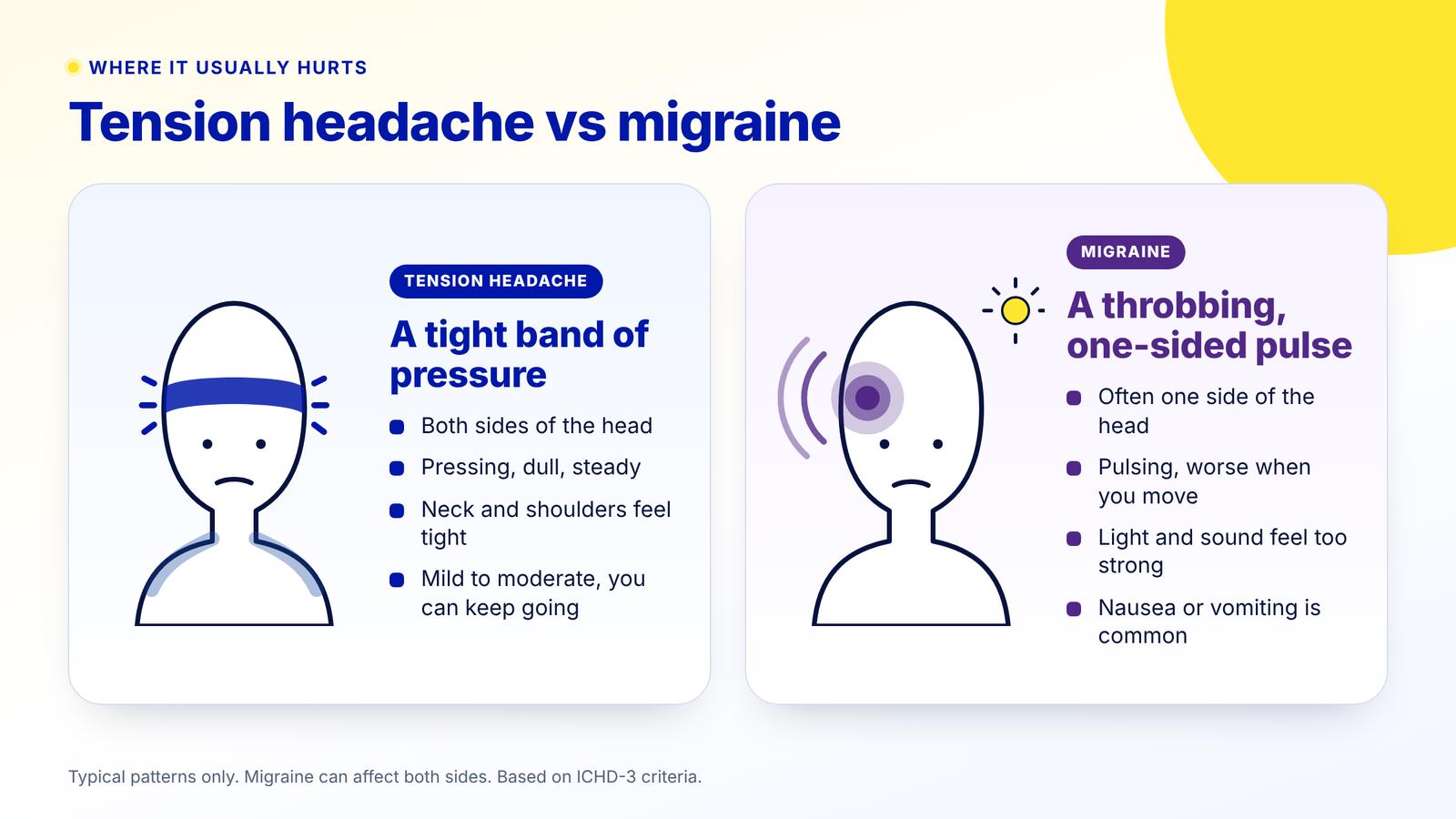
Tension headache vs migraine, mapped: a band of pressure on both sides compared with a one-sided throb.
What a tension headache feels like
Tension headache is the most common type of headache, according to MedlinePlus.
People describe the pain as pressure, tightness or a band around the forehead, temples or back of the head, often after a day of stress. It’s usually mild to moderate. It often spreads into the neck and shoulders, and those muscles may feel sore when you press on them.
An episode can last from 30 minutes to several hours, and the formal ICHD-3 criteria allow up to seven days. Routine physical activity doesn’t make it worse. A walk may even help. Stomach symptoms aren’t part of the picture.
Common drivers are muscle tension from stress, long hours at a screen with poor posture, jaw clenching, eye strain, dehydration and short sleep. If tension headaches show up on 15 or more days a month for over three months, doctors call it chronic tension-type headache (StatPearls). At that point you need a real treatment plan, not more pills.
What a migraine feels like
Migraine is a neurological disease. It’s also far more common in women: U.S. survey data put migraine or severe headache at about 21% of women versus 10% of men (American Headache Society).
A migraine attack can move through up to four phases, as described by the National Institute of Neurological Disorders and Stroke:
- Prodrome. Hours to days before the pain: yawning, food cravings, mood changes.
- Aura. Only some people get these warning symptoms. Zigzag lines, blind spots, tingling or trouble finding words, usually for less than an hour.
- Headache. Moderate to severe, often throbbing and one-sided. Sensitivity to light, sound and smells is typical, and nausea or vomiting is common.
- Postdrome. The “migraine hangover.” You feel drained, foggy or dizzy for up to two days.
Untreated, the headache phase usually lasts 4 to 72 hours. If an attack sends you to a dark, quiet room, that’s a strong hint.
Tension headache vs migraine at a glance
Here’s how the two compare on the symptoms doctors use to tell them apart, based on ICHD-3 and StatPearls.
| Tension headache | Migraine | |
|---|---|---|
| How it feels | Pressing, tight, band-like | Throbbing or pulsing |
| Where | Usually both sides of the head | Often one side of the head |
| How bad | Mild to moderate | Moderate to severe |
| How long | 30 minutes to 7 days | 4 to 72 hours |
| Physical activity | Doesn’t make it worse | Makes it worse |
| Nausea or vomiting | No | Common |
| Light and sound sensitivity | At most one bothers you | Often both bother you |
| Aura | No | In some people |
| Can you keep going? | Usually | Often not |
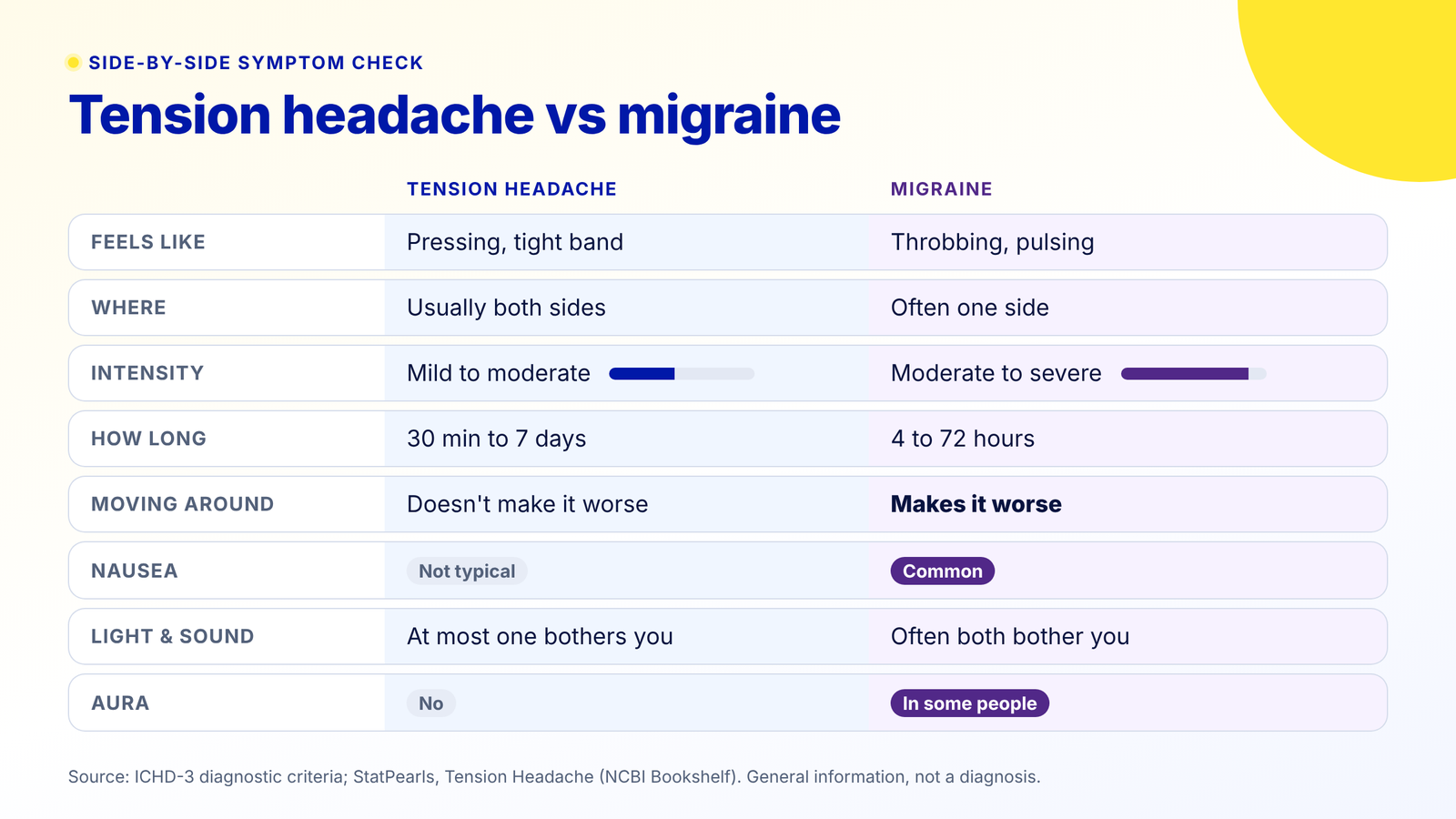
Save this tension headache vs migraine chart for the next time you can’t tell which one you have.
A 60-second self-check you can do mid-headache
Still torn on tension headache vs migraine? Many primary care doctors use a three-question screener called ID Migraine. It was checked against neurologist diagnoses in American primary care and headache clinics, and it’s short enough to run on yourself. Think back three months:
- Did light bother you a lot more than usual?
- Did you feel nauseated or sick to your stomach?
- Did a headache limit your ability to work, study or do what you needed to for at least a day?
Two or three yes answers make migraine likely. In primary care, two or more yeses put the odds of migraine at about 62%, versus roughly 11% for zero or one, according to the American Academy of Family Physicians.
Then add three checks of your own:
- The stairs test. Walk up a flight. Worse? That points toward migraine.
- The side test. Is the pain clearly on one side? Another migraine clue.
- The pattern test. Has this same headache happened five or more times? Migraine is diagnosed on a pattern, not one bad day.
None of this is a diagnosis. It’s a way to walk into a visit with your symptoms clearly described. A headache diary helps even more. Jot down the date, your symptoms, how long it lasted, what you took, and how you ate, drank and slept the day before.
Why so many migraines get called “stress headaches”
Here’s what most guides skip. Plenty of people who say they get tension headaches actually have migraine, and they’ve treated the wrong thing for years.
Part of the mix-up is the neck. In a large population study in the journal Cephalalgia, about 76% of people with migraine alone reported neck pain (Ashina and colleagues, 2015). A stiff neck feels like tension, so people assume that’s the cause.
“Sinus headaches” cause the same confusion. In one primary care study of nearly 3,000 people with a sinus headache label, close to 90% met the criteria for migraine (Consultant360 review).
And stress triggers both. So “it started during a rough week” doesn’t settle tension headache vs migraine. Your symptoms do.
Common triggers for each
The triggers overlap more than you’d expect. What differs is how sensitive your brain is to them.
Tension headache triggers tend to be physical and steady. Think hours hunched over a laptop with poor posture, a clenched jaw, tight neck muscles, stress or a bad night’s sleep.
Migraine triggers are often about change. NINDS lists emotional stress, too much or too little sleep, skipped meals, strong smells, bright or flickering lights, weather shifts, heavy drinking and hormone changes around periods or pregnancy. Dehydration is a common one too. Caffeine cuts both ways: a little helps some people, but too much, or sudden withdrawal, can set off an attack.
The same lifestyle basics help with both. Keep regular sleep times and steady meals, keep up your hydration through the day, and set up a desk that supports good posture. These lifestyle changes won’t erase headaches, but they lower how often you get them.
Treatment and relief that actually helps
Getting tension headache vs migraine right matters most here, because each one needs a different treatment.
Easing a tension headache
For an occasional tension headache, over-the-counter pain relievers work well. StatPearls rates ibuprofen 400 mg and acetaminophen 1,000 mg as the most effective single choices, and the two together may beat ibuprofen alone. Follow the label, and check with a clinician first if you have kidney, liver or stomach problems.
Drug-free treatment helps too. Try heat or ice on the neck, a short walk, gentle stretching, massage, or stress management such as slow relaxation breathing. For frequent episodes, physical therapy that strengthens the neck and shoulders and fixes posture has good support. For chronic tension headache, a low dose of amitriptyline is the best-studied preventive medication.
Stopping a migraine early
Timing is everything with migraine treatment. Take your medication at the first sign of pain. Don’t wait to see if it gets bad.
Over-the-counter options can handle a mild attack. For moderate or severe ones, prescription triptans such as sumatriptan are a standard first choice. Newer CGRP medicines can stop an attack or help prevent the next one. Anti-nausea medication helps when vomiting makes pills hard to keep down.
If migraines keep costing you workdays, or you’re edging toward chronic migraine, ask about preventive treatment. Options include some blood pressure drugs, certain antidepressants and anti-seizure drugs, CGRP medicines and, for chronic migraine (15 or more headache days a month), Botox injections, per NINDS.
The rebound trap
Taking pain relievers too often can cause more headaches. It’s called medication overuse headache, and it can happen with either type.
The usual thresholds are plain pain relievers on 15 or more days a month, or triptans and combination pills on 10 or more days a month, for at least three months (NHS Scotland guidance). MedlinePlus says to call your provider if you need pain medicine more than three days a week. Sound familiar? Don’t quit everything at once on your own. Get a treatment plan.
When to see a doctor (and when to go to the ER)
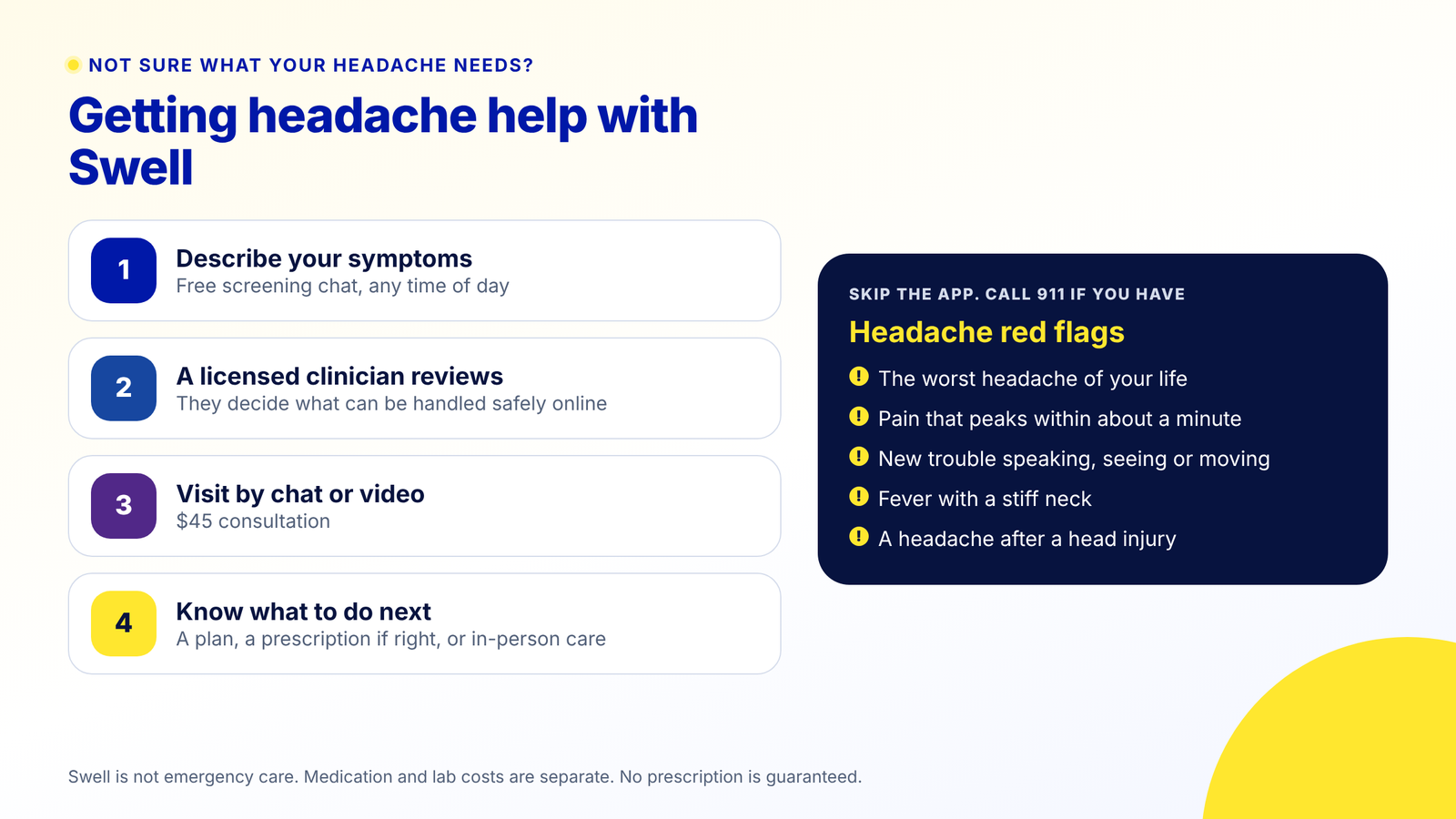
Most headaches aren’t dangerous. A few patterns are. Call 911 or go to the ER if you have any of these symptoms:
- The worst headache of your life, or one that hits full force within about a minute (a thunderclap headache)
- New neurological symptoms such as trouble speaking, seeing or moving, or loss of balance, especially if it isn’t your usual aura
- A headache with high fever, a stiff neck or repeated vomiting
- A headache after a blow to the head
Book a regular visit if your headache symptoms or pattern change, if over-the-counter treatment that used to work stops working, if headaches get worse when you lie down, or if you’re pregnant and getting new headaches.
Stuck between “this can wait” and “I should be seen”? That’s exactly what Swell Medical is built for. You describe what’s going on in a free screening chat, and a licensed clinician reviews it and tells you what can be handled online. If a visit makes sense, it’s $45 by secure chat or video, 24/7. Your clinician can review your symptoms, help sort out tension headache vs migraine, suggest a treatment plan and tell you plainly if you need an in-person exam. Swell isn’t emergency care, so for any of the red flags above, call 911.
Questions people ask about tension headaches and migraines
Can a tension headache turn into a migraine?
Not exactly, since they’re separate conditions. But many people with migraine also get tension headaches, and a migraine can start as mild, pressing pain that builds into a throbbing attack. If your “tension headaches” often get worse, bring nausea or cause light sensitivity, they may be early migraines. Tracking your symptoms in a headache diary usually makes the pattern clear.
Can you have both at the same time?
Yes, and it’s common. Doctors diagnose each one on its own. You might get a tension headache after a long week at a desk and a migraine around your period. Treatment is the tricky part, because pills that ease a tension headache may do little for a full migraine attack. Sorting out tension headache vs migraine helps you pick the right medication at the right time.
What is the 5-4-3-2-1 rule for migraines?
It’s a memory aid for the formal migraine criteria. Five or more attacks. Each lasting 4 to 72 hours. Three of six aura features, for migraine with aura (some versions use the 3 for “up to three days” instead). At least two pain features, such as throbbing or one-sided pain. At least one extra symptom, like nausea or sensitivity to light and sound. Treat it as a quick guide, not a diagnosis.
What’s the fastest way to relieve a tension headache?
For most adults, the fastest way to relieve a tension headache is an over-the-counter pain reliever such as ibuprofen or acetaminophen, taken as the label directs. Then take a real break from whatever is tightening your neck. Warmth on the shoulders, a glass of water and a short walk help many people. If you need pills more than a few days a week, talk to a clinician.
Trusted references
Public-health, research, and medical-society resources related to this guide.
- MedlinePlus: Tension headache
- ICHD-3: Infrequent episodic tension-type headache
- NCBI StatPearls: Headache review (NBK562274)
- American Headache Society: Prevalence of migraine and severe headache
- NINDS: Migraine information page
- American Family Physician (2006): ID Migraine screener
- Mount Sinai Scholars: Ashina et al. (2015), neck pain in migraine and tension-type headache
- Consultant360: Sinus headache and migraine, overlapping symptoms
- NHS Scotland: Medication overuse headache guidance