It’s 2 a.m. Your chest is tight, your pulse is racing, and one thought is louder than the rest: is this my heart?
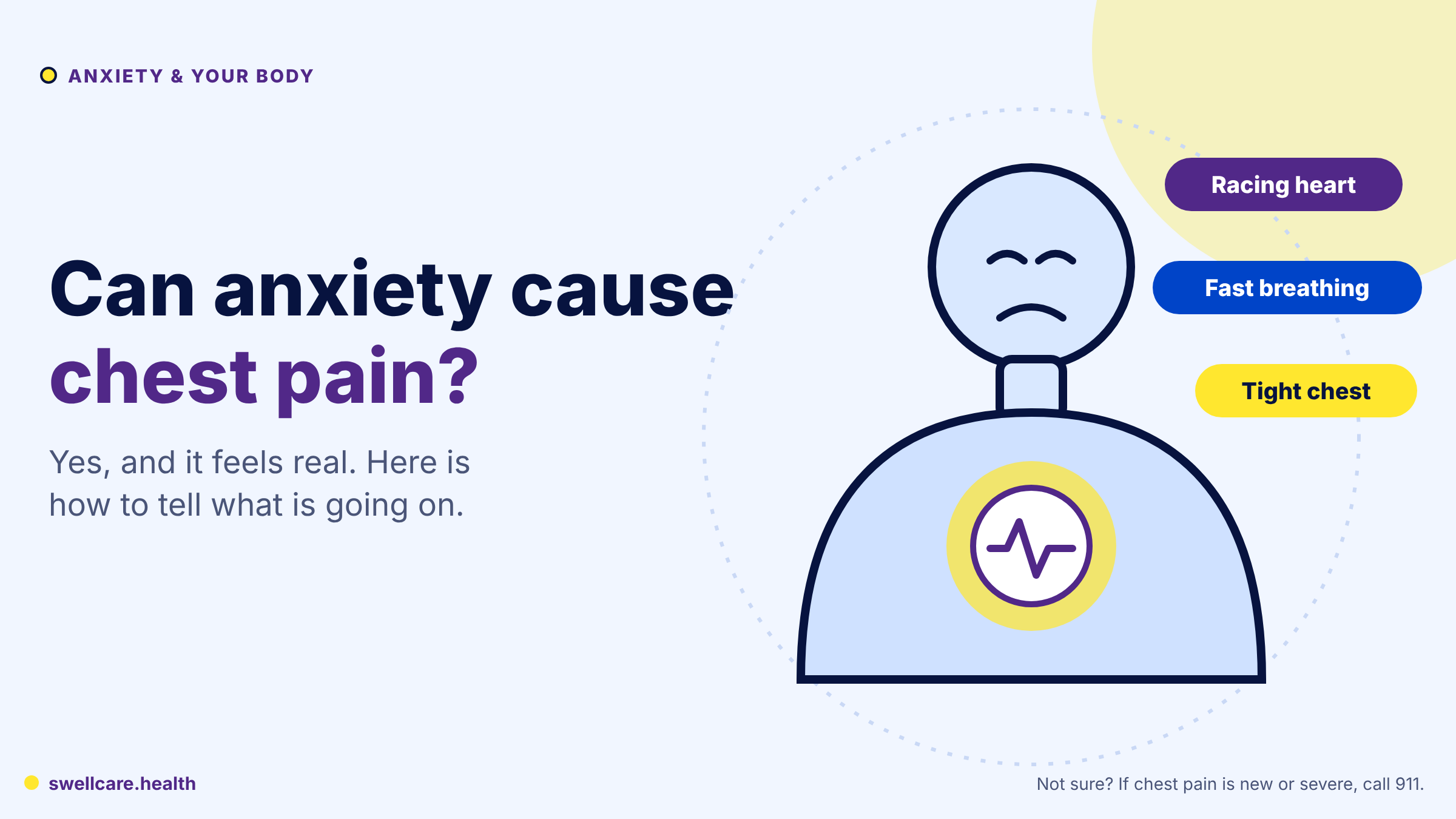
So, can anxiety cause chest pain? Yes. It’s one of the most common reasons people end up in an emergency room sure that something is wrong with their heart. The pain is real, not imagined. But a heart attack can feel almost the same, and you can’t reliably sort one from the other on your own. Our rule is simple. If the pain is new, severe or confusing, call 911 first and find the cause later.
Can anxiety cause chest pain? What happens in your body
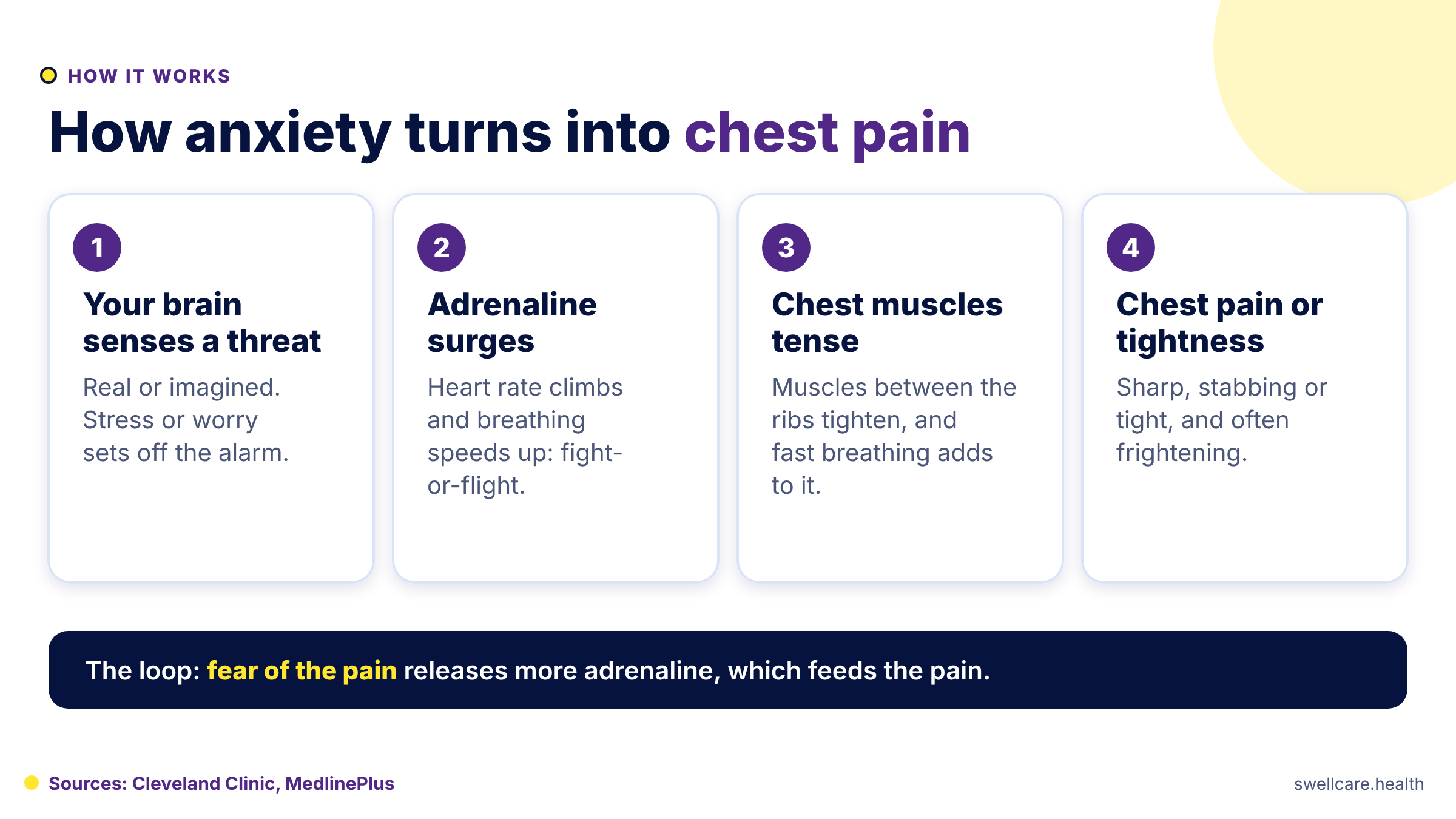
Think of anxiety as your body’s alarm system stuck in the on position. Stress doesn’t always feel like worry, either. Some people feel it only as a physical jolt. When your brain senses a threat, real or imagined, it releases adrenaline. This is the fight-or-flight response. Your heart rate climbs, your breathing speeds up, and your muscles brace for action, including the small ones between your ribs.
Those tense muscles can spasm and hurt, which is why anxiety chest pain feels so physical. Fast, shallow breathing (hyperventilation) adds to the tightness. Then comes the loop: the pain frightens you, the fear drives more stress, and the anxiety feeds the pain, as Cleveland Clinic describes it.
Doctors call chest pain that isn’t caused by the heart non-cardiac chest pain. It’s common. The American Heart Association says chest pain sends more than 6.5 million people to U.S. emergency departments each year, and most cases turn out not to involve the heart, according to Harvard Health.
What anxiety chest pain feels like
No two people describe it the same way. Most land on one of a few patterns.
Sharp, stabbing or tight
Many people report a sudden, sharp or stabbing pain near the center of the chest. Others feel chest tightness, as if a band were pulled around the ribs. It can sit in one spot or move around. Cleveland Clinic notes that it usually fades by itself, sometimes within minutes and sometimes after an hour or two.
The symptoms that tag along
Anxiety symptoms rarely show up alone. MedlinePlus lists a pounding heartbeat, shortness of breath, dizziness, nausea, sweating or chills, trembling, and tingling in the hands or face among the symptoms of a panic attack. Hyperventilation often joins in, and heavy sweating is common too. A panic attack comes on fast and usually peaks within 10 to 20 minutes, though some symptoms can last an hour or longer.
Anxiety or heart attack? A side-by-side comparison
Here’s where it gets tricky. Both can cause chest pain, a racing heart and shortness of breath. Their symptoms overlap so much that the differences below are clues, not a diagnosis. Cardiac pain is more often described as heavy pressure, while anxiety pain runs sharper.
| Anxiety or panic attack | Heart attack | |
|---|---|---|
| How it starts | Often abrupt, with a wave of fear; peaks in about 10 minutes | Often builds over several minutes, or comes and goes |
| What it feels like | Sharp, stabbing or tight | Pressure, squeezing or heaviness |
| Where it travels | Tends to stay in the chest | May spread to the arm, shoulder, jaw, neck or back |
| How long it lasts | Minutes, then fades | Several minutes or longer, or returns after easing |
| Other clues | Intense fear, tingling in hands or face | Cold sweat, nausea, unusual tiredness, lightheadedness |
Sources: American Heart Association, Cleveland Clinic, Mayo Clinic.
Women may notice different heart attack symptoms. They’re more likely to have breathlessness, stomach upset, or pain in the back or jaw, the AHA reports. And having no known risk factors doesn’t rule out heart disease.
The AHA’s advice is blunt: if you can’t tell, treat it as a possible heart attack. A normal heart workup plus intense fear makes a panic attack more likely, but a clinician confirms that after the fact. Anxiety symptoms alone never settle it.
What helps anxiety chest pain right now
Only use these steps when you have no emergency warning signs (see the next section). If anything on that list fits, skip this part and call 911.
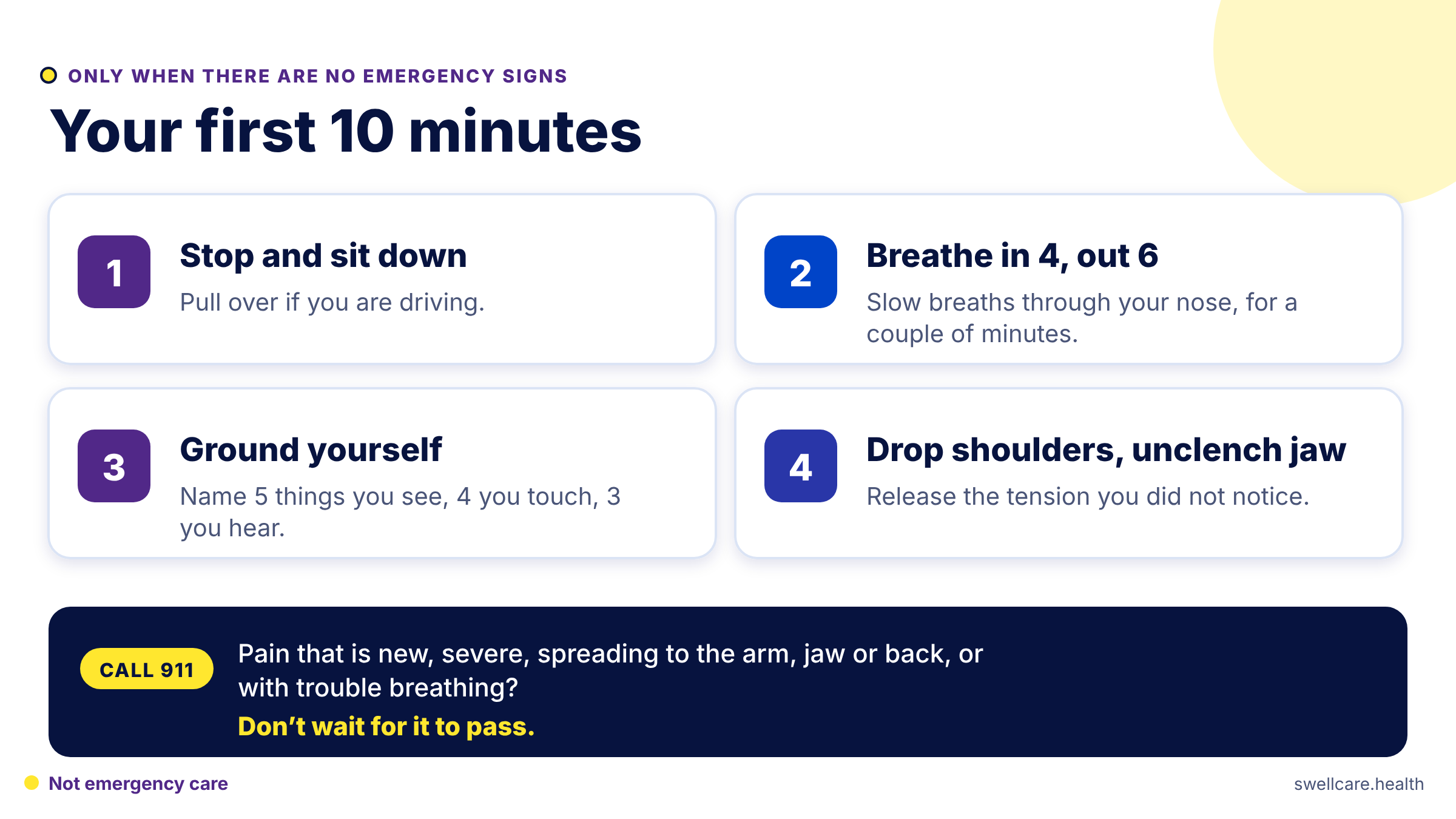
In the first ten minutes
- Stop and sit down. If you’re driving, pull over somewhere safe.
- Slow your breathing. Breathe in through your nose for four counts, then out for six. Keep up the deep breathing for a couple of minutes. Deep breathing tells your body the danger has passed and eases muscle tension in the chest.
- Ground yourself. Name five things you can see, four you can touch, three you can hear. It pulls your attention out of the spiral.
- Drop your shoulders and unclench your jaw. Most of us hold stress there without noticing. A short round of relaxation, tensing and then releasing each muscle group, helps too.
- Give it time. Anxiety chest pain should ease. If it doesn’t, or it gets worse, treat it as an emergency.
Over the next few weeks
Quick fixes calm the moment. They don’t change why it keeps happening. The National Institute of Mental Health says about a third of U.S. adolescents and adults will have an anxiety disorder at some point, and treatment works. Cognitive behavioral therapy and, for some people, medication can reduce how often panic attacks come. Treatment plans differ, so the best treatment is the one a clinician builds around you.
Smaller habits count too. Stress, poor sleep and caffeine all push the alarm button, so cut back where you can. Try relaxation practice such as mindfulness, yoga or progressive muscle relaxation, and keep a simple log of your symptoms and when the pain shows up. Patterns are useful to a clinician. If worry runs most days, ask about generalized anxiety disorder and which mental health treatment fits you.
When to call 911 or see a doctor
Call 911 right away if chest pain is new and unexplained, lasts more than a few minutes, or comes with any of these, according to Harvard Health and Mayo Clinic:
- Shortness of breath
- Pain in the jaw, neck, back or arms
- Nausea, weakness, fainting or dizziness
- Cold sweats or a sense that something is badly wrong
Don’t wait to see if it passes. And don’t drive yourself unless there’s truly no other option. Paramedics can start treatment on arrival.
If this is your first episode, see a doctor to rule out a cardiac cause, even if you suspect anxiety. If it keeps coming back, book a visit anyway, especially when stress is building. Your clinician can check for other causes and point you to real treatment.
Next step: get a clinician in your corner
Swell is not emergency care, and new or severe chest pain always means 911. But once a doctor has checked your heart and you still have questions about stress, sleep or what comes next, our licensed clinicians are online 24/7.
Start with a free screening. A clinician reviews your situation and tells you whether an online visit is the right fit, and if it isn’t, they’ll say so. A consultation is $45 after screening. See how it works or get care now.
Questions people ask about anxiety and chest pain
How do I know if my chest pain is from anxiety?
On your own, you often can’t. Clues that lean toward anxiety include sharp, brief pain during a stressful moment that eases with slow breathing and stays put in the chest. But a first episode still deserves a medical check. Only an exam and tests can confirm the heart is fine.
How long does anxiety chest pain last?
A panic episode typically peaks within about 10 minutes, and MedlinePlus puts the usual peak at 10 to 20 minutes. Some symptoms linger an hour or longer. Pain that lasts many minutes without easing, or returns again and again, should be checked right away.
Can anxiety cause chest pain every day?
It can. Constant worry and stress keep muscles tense and breathing shallow, so ongoing anxiety can leave a dull ache or tightness that lasts through the day. Daily chest pain is still worth a doctor’s visit. Once other causes are ruled out, a clinician can help you build a plan to lower the baseline.
What is the 3-3-3 rule for anxiety?
It’s a quick grounding trick. Name three things you see, name three sounds you hear, then move three parts of your body, such as your fingers, shoulders and ankles. It isn’t a medical treatment. It simply gives a racing mind something concrete to hold on to.
Trusted references
Public-health, research, and medical-society resources related to this guide.