You're sitting carefully. Every trip to the bathroom feels like a negotiation. And you want one number.
Here it is: most mild hemorrhoids shrink within a week of good home care, according to the Cleveland Clinic. The exception is a clotted hemorrhoid, which can leave a firm lump for four to six weeks. So the honest answer to "how long does it take a hemorrhoid to shrink" is days for most people, weeks for a few.
Below: the timeline for each type of hemorrhoids, how to tell they're healing, what speeds things up and when not to wait it out.
The short answer: most shrink in about a week
Hemorrhoids are swollen veins in the lower rectum and around the anus. Everyone has these cushions of veins. They only become a problem when they swell, itch, bleed or hurt, usually during flare-ups triggered by straining or constipation.
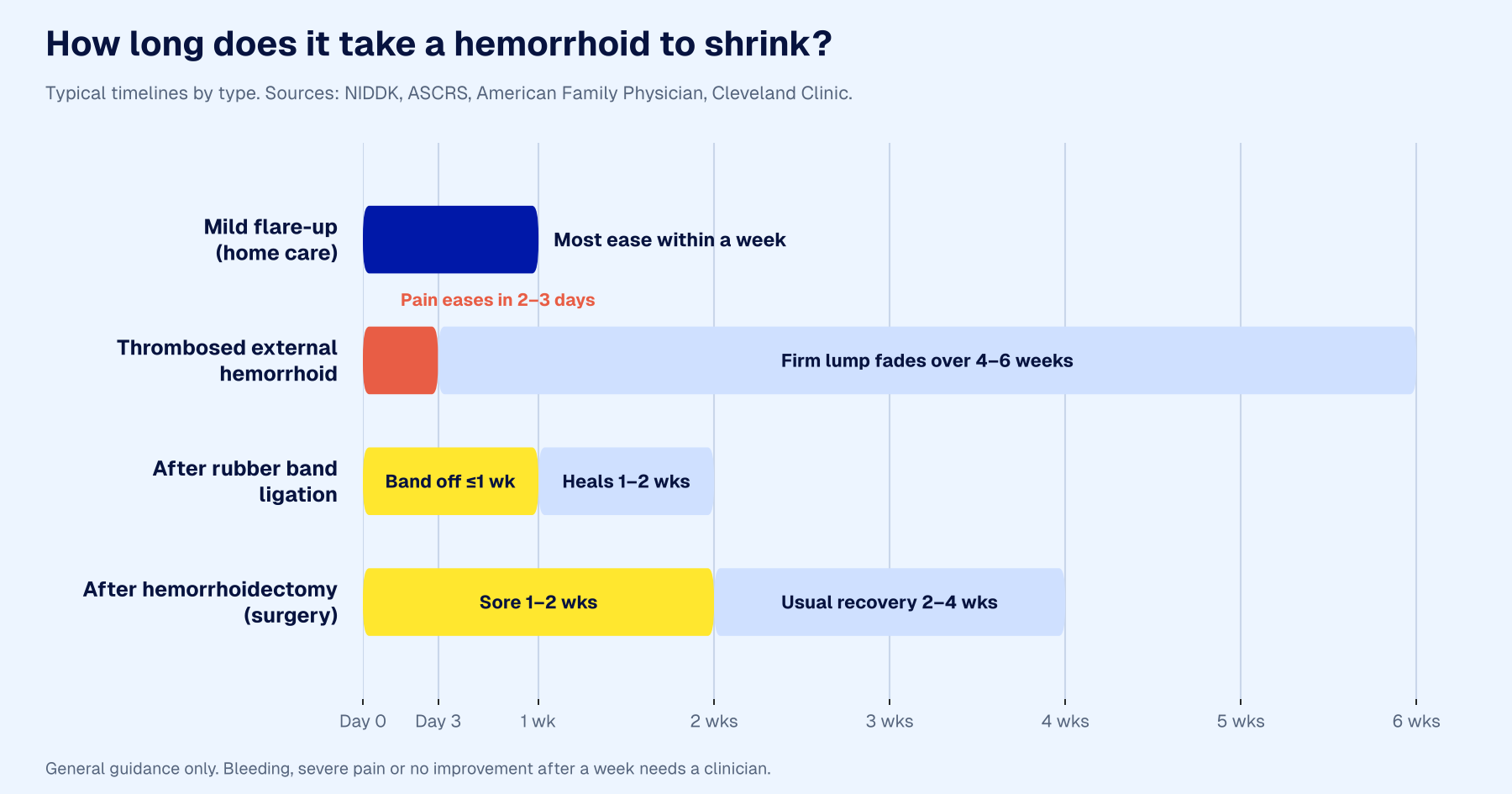
| Situation | Typical time to shrink or settle |
|---|---|
| Mild flare-up with home care | A few days; most improve within a week |
| Clotted external hemorrhoid, no procedure | Soreness eases in 2–3 days; lump fades over several weeks |
| After rubber band ligation | Band falls off within about a week; heals in 1–2 weeks |
| After hemorrhoidectomy (surgery) | Usually 2–4 weeks, sometimes up to 8 |
Sources: NIDDK, ASCRS, American Family Physician, Cleveland Clinic.
Hemorrhoid shrinking time by type
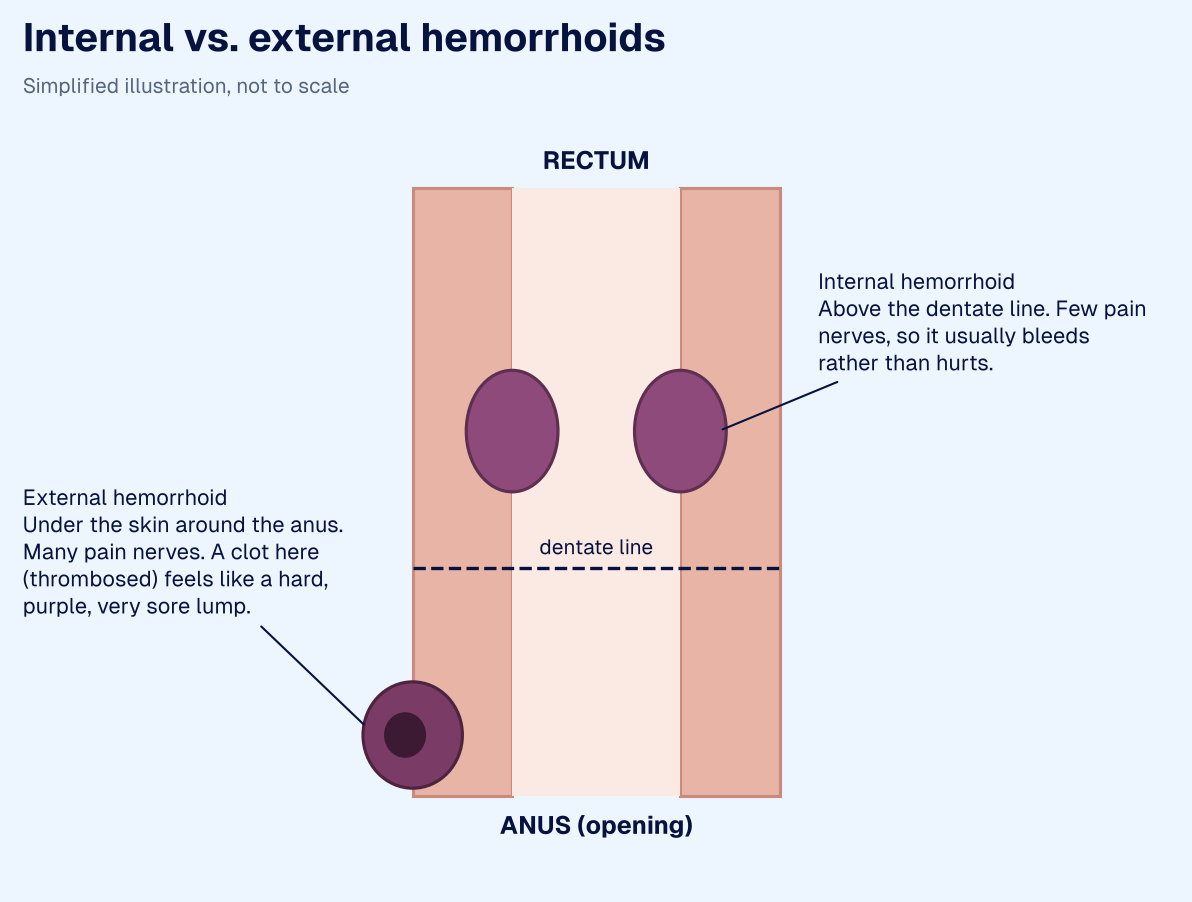
Where hemorrhoids sit changes how they feel and how fast they settle.
Internal hemorrhoids
Internal hemorrhoids sit inside the rectum, above a boundary called the dentate line. Few pain nerves live up there. The usual sign is bright red blood on the toilet paper.
Doctors grade them from 1 to 4 (AAFP). The mildest may bleed but don't bulge. The next level slips out during bowel movements and goes back on its own. Third-degree hemorrhoids have to be pushed back in, and fourth-degree prolapsed hemorrhoids stay out.
Mild internal hemorrhoids usually calm down in a few days to a week once stool is soft. Most prolapsed internal hemorrhoids go away without at-home treatment, says the NIDDK. Severe or stubborn ones may need a procedure.
External hemorrhoids
External hemorrhoids form under the skin around the anus. Lots of nerves live here, so swelling, itching and soreness are the main complaints. A mild flare usually settles in about a week. Leftover skin tags may stay once the swelling goes down. Those won't shrink further.
Thrombosed hemorrhoids
This is the slow one. A blood clot forms inside an external hemorrhoid and leaves a hard, purple, very tender lump.
Without a procedure, the pain typically improves over two to three days and the clot is absorbed over several weeks (AAFP). The ASCRS says the firm lump should recede within four to six weeks.
If a thrombosed external hemorrhoid is removed within 72 hours of symptoms starting, relief comes far sooner: 3.9 days with excision versus 24 days with conservative care in one review (AAFP 2020). After that window, home care usually wins.
During pregnancy and after birth
Pregnancy adds pressure on pelvic veins and makes constipation common, so hemorrhoids often show up late in pregnancy or after pushing during delivery. Many ease in the weeks after birth as that pressure drops. A warm bath, ice packs and extra fiber in your diet are sensible first steps (ACOG). Ask your OB before using any medicated cream.
What actually makes a hemorrhoid shrink
Hemorrhoids swell because blood pools in stretched veins and the tissue gets inflamed. They shrink once the pressure comes off, inflammation settles and normal blood flow returns.
Straining is the big enemy. So is scrolling your phone on the toilet, which lets the area hang and fill with blood. Hard stool, diarrhea, heavy lifting and long hours at a desk keep the pressure on. Remove those and most hemorrhoids deflate on their own.
Signs your hemorrhoid is shrinking
Not sure your hemorrhoids are improving? Look for steady, small wins over several days.
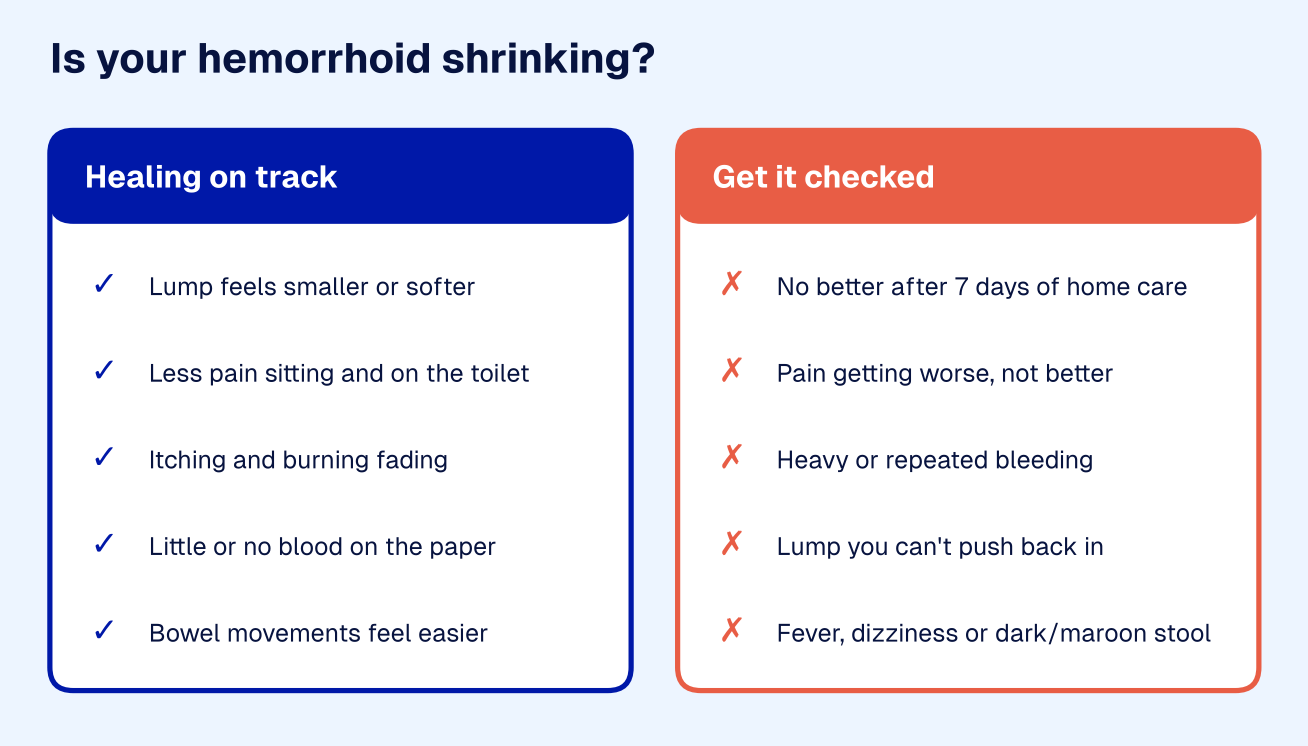
You're on track if the lump feels smaller or softer, sitting hurts less, itching is fading, there's little blood on the paper and bowel movements feel easier.
It's not shrinking if things are getting worse, bleeding is heavy or recurring, the lump won't go back in, or nothing has changed after a week. Those symptoms deserve a proper look.
How to help a hemorrhoid shrink faster
You can't make hemorrhoids vanish overnight. You can remove what keeps them swollen. This plan follows NIDDK and ASCRS guidance.
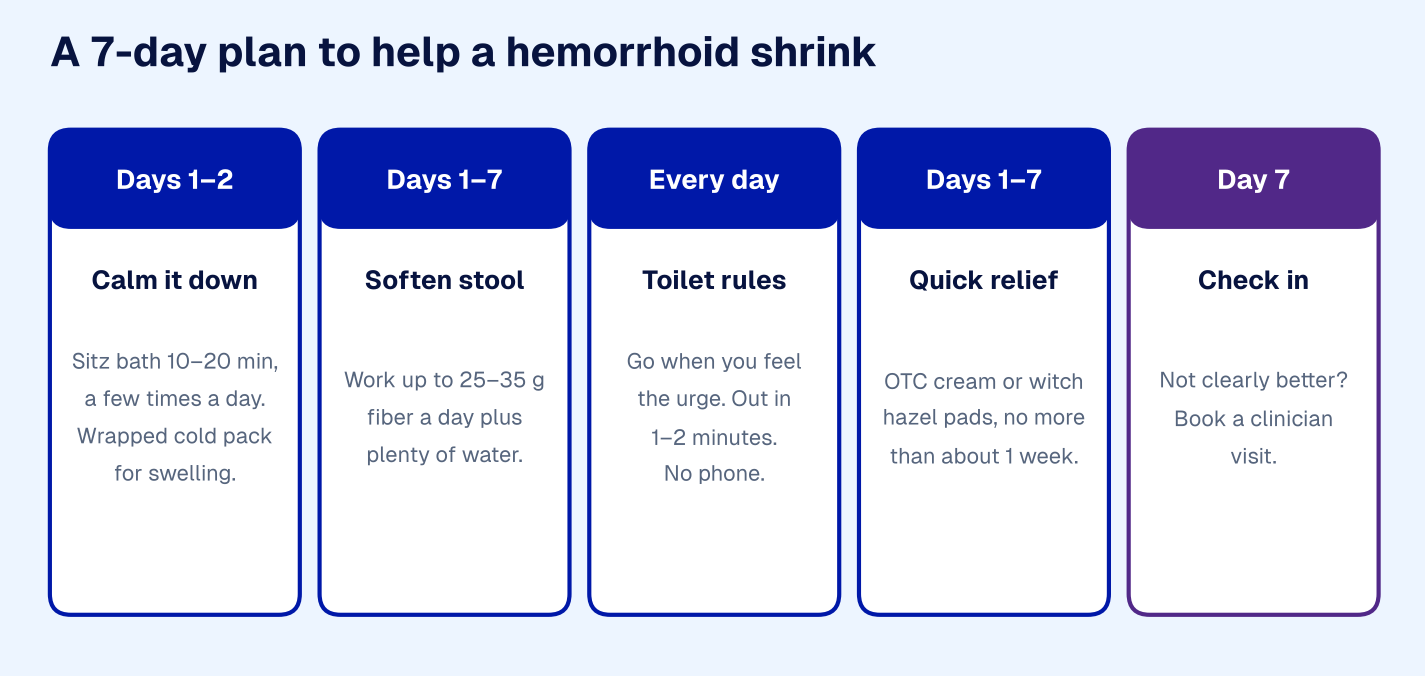
- Soak. Sitz baths for 10 to 20 minutes, a few times a day.
- Soften your stool. Aim for 25 to 35 grams of fiber a day from your diet or a psyllium supplement. Good hydration matters just as much. Add fiber slowly or you'll trade soreness for gas.
- Stop straining. Go when you feel the urge. Don't push. Be done in one to two minutes.
- Cool the swelling. Cold compresses, wrapped in cloth, take the edge off.
- Use over-the-counter relief briefly. Hydrocortisone cream, lidocaine or witch hazel pads ease itching and soreness. Over-the-counter pain relievers such as acetaminophen also help. Doctors usually suggest creams for about a week, since longer steroid use can thin the skin.
- Keep moving. A short daily walk keeps bowel movements regular.
That advice isn't folklore. A Cochrane review of seven trials found it cut the risk of persistent symptoms by 53% and bleeding by 50%. Think of it this way: creams and witch hazel treat the symptoms, while softer stool treats the cause.
Office treatments that shorten the timeline
If hemorrhoids keep bleeding or prolapsing after a few weeks of home care, a quick, minimally invasive office treatment can shrink them. Most take minutes, with little downtime.
| Treatment | How it works | Recovery |
|---|---|---|
| Rubber band ligation | A band cuts off blood supply; the hemorrhoid shrivels and falls off | Falls off within about a week; heals in 1–2 weeks |
| Infrared coagulation | Heat scars small internal hemorrhoids so they shrink | Little downtime |
| Sclerotherapy | An injection scars the vessel shut | Little downtime |
| Clot removal (excision) | Clot cut out under local anesthetic | Fastest relief if done early |
| Hemorrhoidectomy | Surgical removal of large or stubborn hemorrhoids | 2–4 weeks on average |
For most bleeding or bulging internal hemorrhoids, rubber band ligation is the go-to. It brings relief for months to years in 70.5% to 97% of people (AAFP) and beats infrared coagulation and sclerotherapy head to head (AAFP 2020).
Surgery is saved for large external hemorrhoids, hemorrhoids that stay prolapsed, or cases where other medical treatment hasn't worked. After a hemorrhoidectomy, pain usually improves after three days and keeps easing for two weeks (Cleveland Clinic).
Why some hemorrhoids keep coming back
Recurrence is common when lifestyle and bowel habits don't change. Chronic constipation, a low-fiber diet, long hours sitting and regular heavy lifting all raise the odds of recurring hemorrhoids. Even after banding, the recurrence rate is 11% to 49% at one year (AAFP 2020).
The lifestyle habits that help hemorrhoids shrink are the same ones that stop them coming back. Keep the fiber, the water and the quick bathroom visits going after you feel better. Those lifestyle changes are cheap insurance against the next round of chronic flare-ups.
When to see a doctor
Don't wait out these symptoms:
- Heavy or repeated rectal bleeding, or blood that looks dark or maroon
- Severe pain, especially a hard, purple lump near the anus (a clot is easier to treat early)
- A lump you can't push back inside the anus
- Fever, chills, dizziness or belly pain
- No improvement after a week of home care
Blood from the rectum isn't always from hemorrhoids, which is why ongoing rectal bleeding deserves a real diagnosis. Fissures, inflammatory bowel disease and colorectal cancer can bleed too. ASCRS advises screening from age 45, and a doctor may order a colonoscopy if your bleeding has no clear cause. A colon and rectal surgeon handles stubborn cases.
Not sure whether your hemorrhoids need attention? SwellCare clinicians are available 24/7 by virtual visit in all 50 states. We can review your symptoms, recommend the right treatment for where you are in the timeline and tell you if an in-person exam makes sense. Start a SwellCare visit.
Questions people ask about hemorrhoid healing time
What shrinks a hemorrhoid the fastest?
For most people, the fastest route is warm sitz baths a few times a day, soft stools from fiber and water, and no straining. Over-the-counter creams mainly ease symptoms. For stubborn internal hemorrhoids, rubber band ligation is the quickest lasting treatment. A fresh clot removed within the first few days feels better almost right away.
How do I know if my hemorrhoid is shrinking?
Shrinking hemorrhoids feel softer or smaller, sitting is less painful, itching fades and there's less blood on the toilet paper. Progress is gradual, so compare day 1 with day 4 rather than morning with evening. If pain is getting worse or nothing has changed after a week, get checked.
How long do hemorrhoids last if untreated?
Mild hemorrhoids often settle in one to two weeks even without much treatment. A clot can take several weeks to fully absorb. Hemorrhoids that prolapse, or that are driven by ongoing constipation, tend to come back again and again until the underlying cause or the hemorrhoids themselves are treated.
Can a hemorrhoid shrink in 2 days?
A small flare can feel much better in two days, especially with warm soaks and softer stool. Full shrinking usually takes closer to a week. Clotted hemorrhoids won't disappear that fast, although the soreness often starts easing around day two or three.
Can hemorrhoids be permanent?
Large hemorrhoids, grade 4 prolapse and the skin tags left after a clot may not go away on their own. They aren't dangerous in most cases, but they can keep causing bleeding, itching or hygiene problems. Office procedures or surgery can remove them when home care isn't enough.
Trusted references
Public-health, research, and medical-society resources related to this guide.