You spot a red, itchy circle on your arm. Or your child’s. It could be ringworm. It could be eczema. And the tube in your medicine cabinet might help one of them and make the other one worse.
That’s the real problem with ringworm vs eczema. The two look alike at first glance, yet they need opposite care. Ringworm is a fungal infection, so it needs an antifungal. Eczema is inflammation of dry, easily irritated skin, so it needs moisture and calming. Below you’ll find each rash described the way a clinician sees it, the clues that separate them, and what to do today.
Why ringworm and eczema get mixed up so often
Both show up as an itchy red or pink patch, and the early symptoms overlap almost completely. Both can be round. Both can flake. On brown and Black skin, either one can look gray, brown or purple-brown instead of red, which makes a quick glance even less reliable.
The names don’t help. Ringworm has nothing to do with worms. It’s a fungal infection of the skin, and the medical name for the body version is tinea corporis. Eczema is a broader skin condition in which the skin barrier is easily irritated, so inflammation turns the area dry and itchy. It’s not an infection at all.
Here’s what surprises people. You can have both at once, because damaged eczema spots can pick up a fungal infection like anywhere else. That’s one more reason a single photo can mislead you, and why symptoms that don’t behave deserve a second look.
Ringworm vs eczema at a glance
| Ringworm | Eczema | |
|---|---|---|
| What it is | Fungal infection of the skin | Inflammation from a long-term skin condition |
| Shape | Round rash with a clearer center | Irregular or coin-shaped patch, no clear center |
| Edge | Raised, scaly, sharply defined | Soft and blurry |
| Itch | Itchy, mild to strong | Often intensely itchy, worse at night |
| Where | One or two spots, anywhere on the body | Often both sides, in elbow creases or on hands and legs |
| Contagious | Yes | No |
| Cause | A fungus | Genes, skin barrier, triggers |
| Treatment | Antifungal | Moisturizer, plus prescription cream during a flare-up |
One row matters most day to day: ringworm is contagious and eczema isn’t, which changes how you handle towels, school and sports.
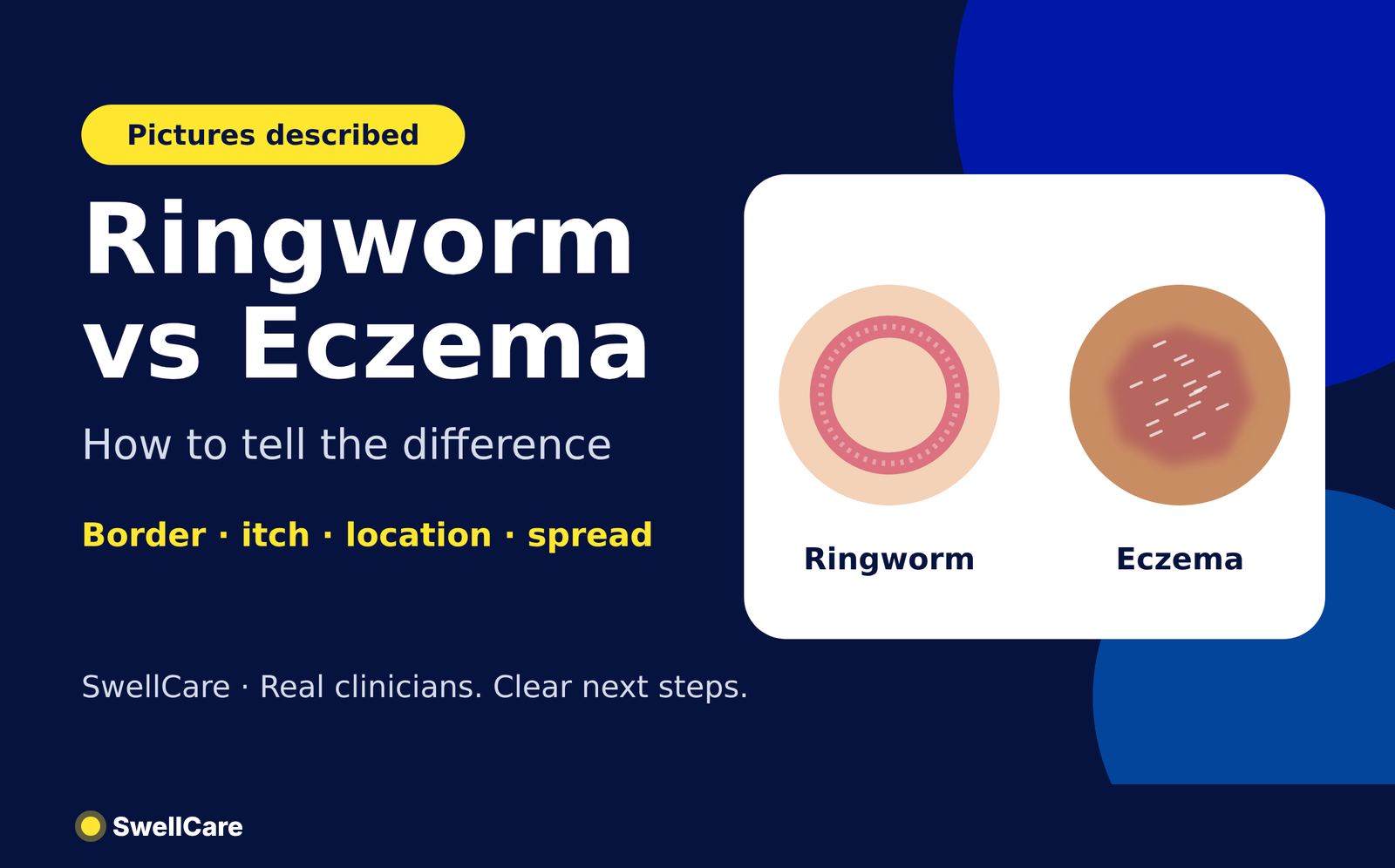
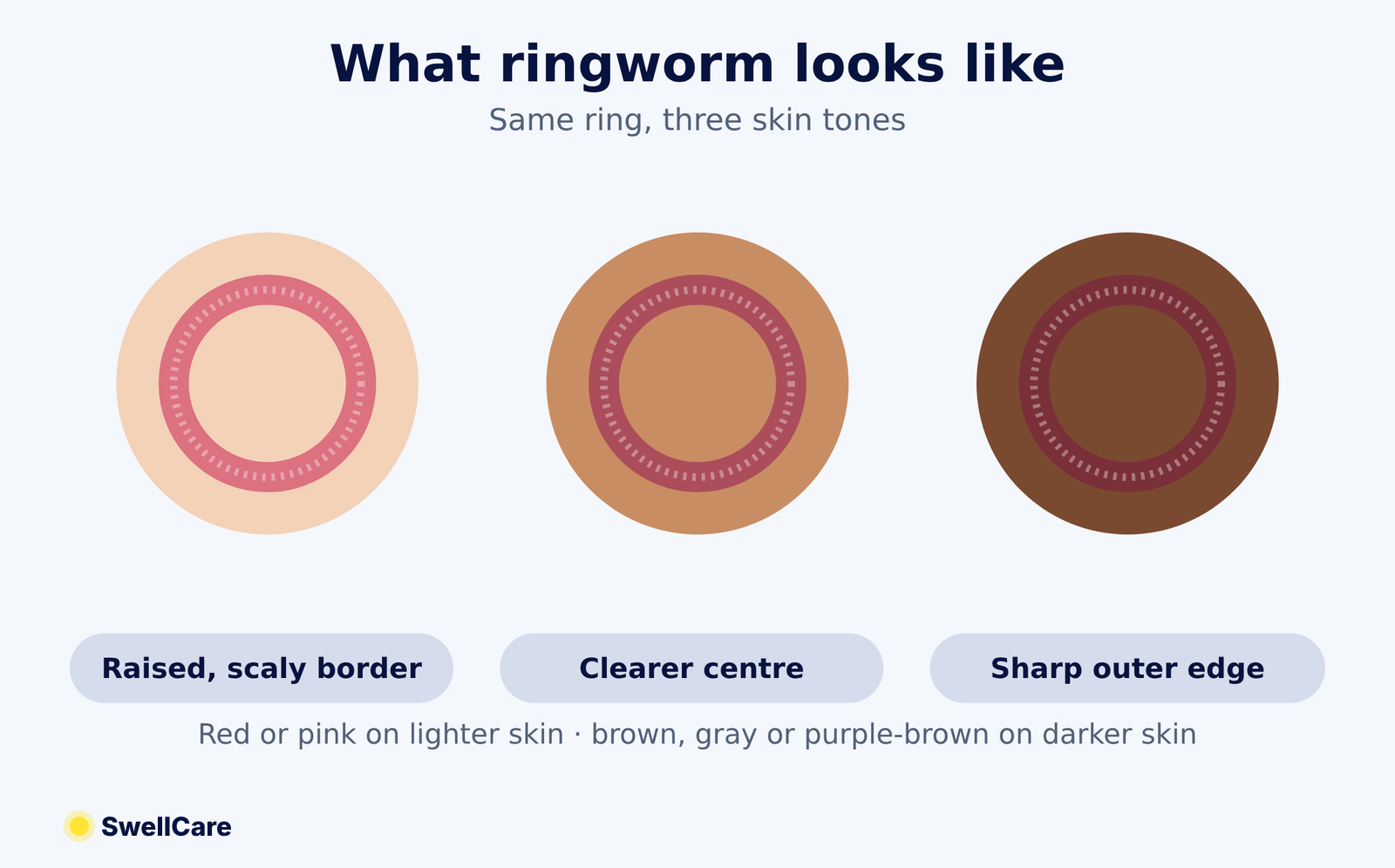
What ringworm looks like (picture described)
Picture a small coin of red skin that has cleared in the middle. The outer ring is slightly raised and scaly, like a thin ridge you can feel with a fingertip. The edge is sharp. Over days the ring creeps outward, and sometimes two rings overlap. Ringworm is a fungal infection, and it spreads from that first spot. Scratch it, touch another part of your body, and you can start a second ring. Early symptoms are easy to miss.
According to the CDC, symptoms usually start 4 to 14 days after contact with the fungus. On lighter skin the ring looks red or pink. On darker skin, the American Academy of Dermatology describes it as brown or gray.
Doctors call these infections tinea. The same fungus family causes athlete’s foot, jock itch and scalp ringworm (tinea capitis), which shows up as a scaly bald spot, mostly in kids. Creams alone won’t clear it.
What eczema looks like (picture described)
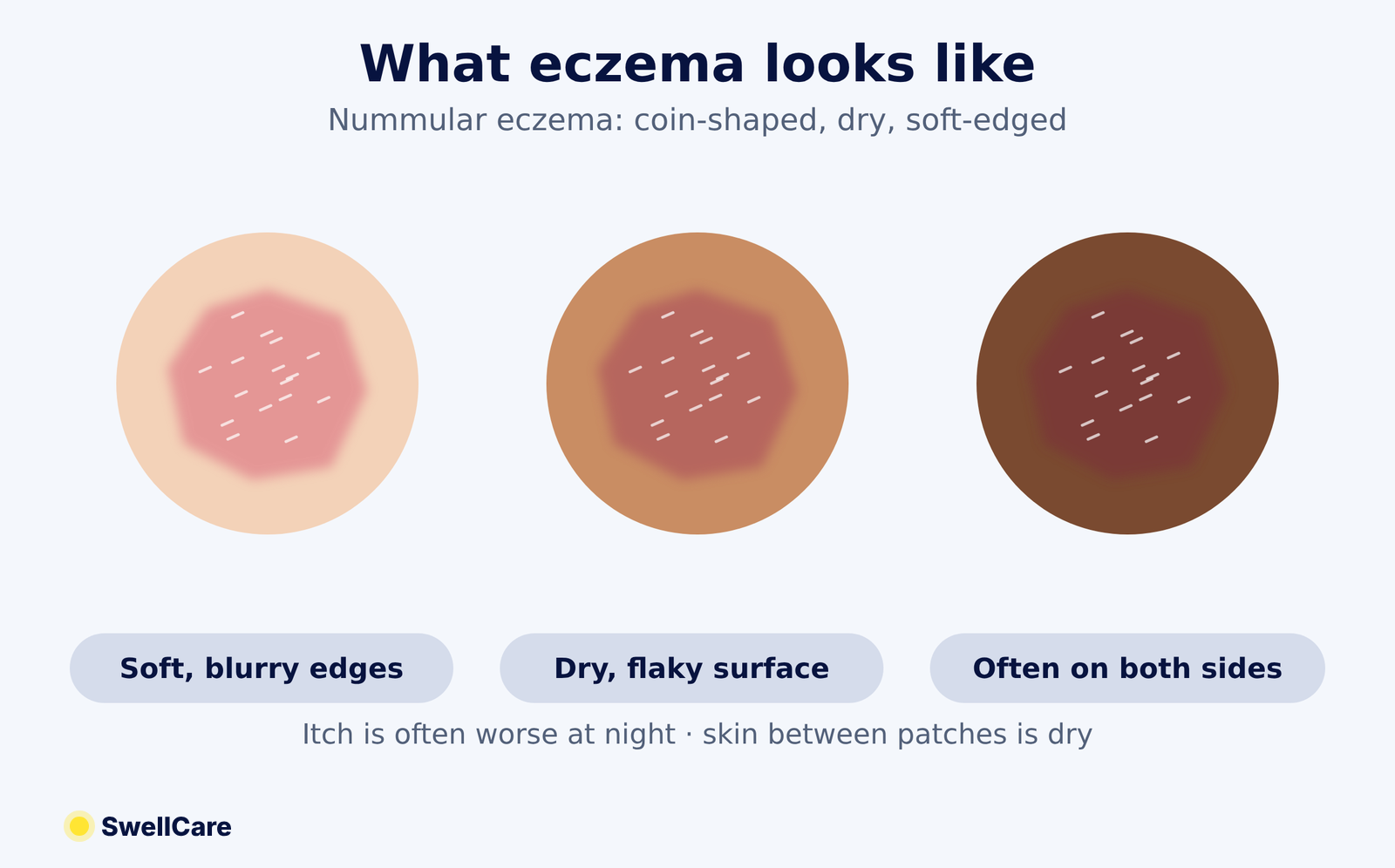
Picture dry, rough skin with soft edges that fade into healthy tissue around it. No tidy ring. No cleared center. During a flare-up the patch can look scaly, cracked or even weepy, and after weeks of scratching it thickens.
Inflammation makes the skin red and sore, and the itchy skin drives everything. Eczema symptoms come in waves: a calm stretch, then a flare-up after a trigger. Eczema often begins in childhood, though adults get eczema too. You scratch, the skin breaks, the itch gets worse. Common triggers include harsh soap, dry air, sweat, stress, wool and allergens.
Nummular eczema: the coin-shaped look-alike
Nummular eczema fools people most. “Nummular” means coin-like. The AAD says it starts as tiny bumps and blister-like sores that crust and merge into round, scaly spots, usually on the legs, forearms or backs of the hands. It’s intensely itchy, and the skin between the spots is very dry.
So what separates it from ringworm? Nummular eczema rarely clears in the center, the edge isn’t a sharp ridge, and the patches often appear on both sides of the body.
Five clues that settle ringworm vs eczema
No single clue is a diagnosis, but together they point the right way in most cases of ringworm vs eczema.
- The border. Ringworm has a defined, raised, scaly edge. Eczema fades out.
- The center. Ringworm tends to clear in the middle. Eczema stays dry and red all the way across.
- The location. One or two new spots, especially after contact with a pet, a gym mat or someone with athlete’s foot, suggest ringworm. Matching patches on both arms or both knees suggest eczema.
- The history. Eczema usually has a past: flares that come and go, often with asthma or hay fever in the family. Ringworm symptoms are typically new.
- The spread. Ringworm can spread to other body areas and to other people, and each new ring is another sign. Eczema can grow, but eczema doesn’t spread from person to person. If a sibling or a pet has a similar spot, think ringworm.
Why steroid cream can backfire on ringworm
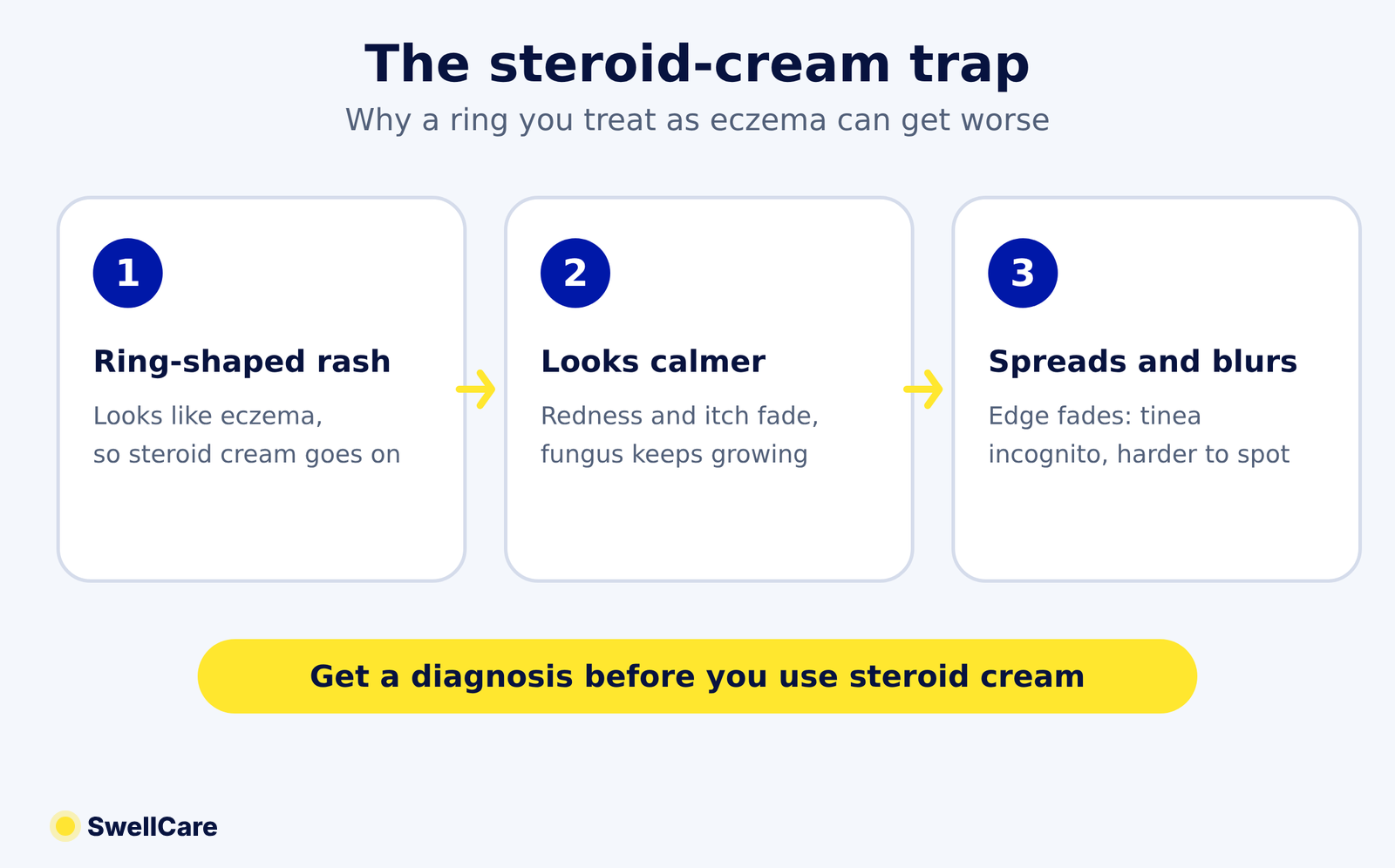
This is a common mistake. A ring-shaped patch looks like eczema, so a cream like hydrocortisone, one of the corticosteroids, goes on. The CDC is blunt about it: don’t use steroid creams or ointments on ringworm or an undiagnosed rash.
Why? These topical creams calm redness and itch, so the rash looks better for a few days. Meanwhile the infection spreads and the fungus keeps growing. Doctors call the result tinea incognito, a fungal infection whose look has been disguised, with a blurry edge and less scale, as a published review explains. It’s harder to recognize and slower to clear.
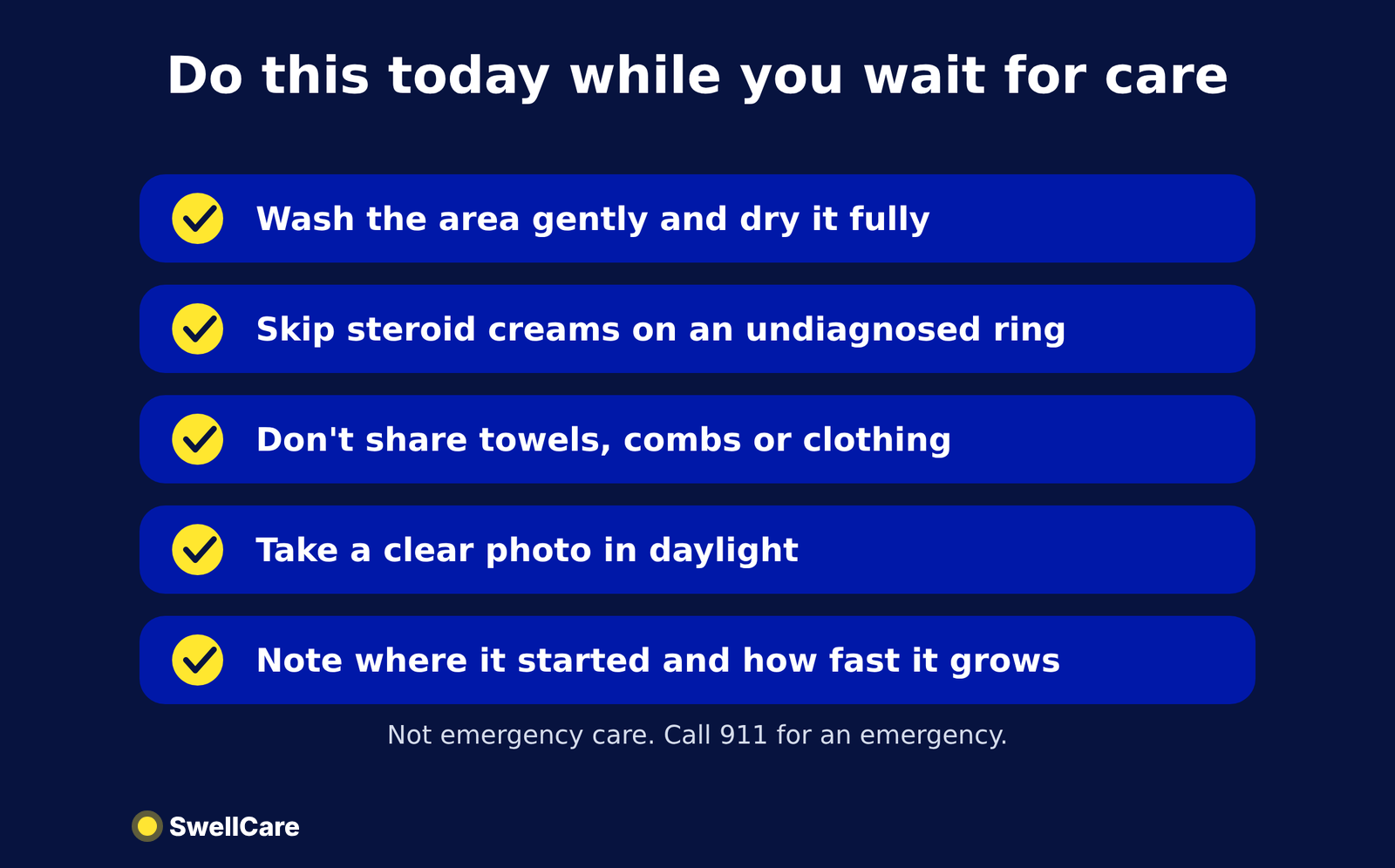
The safe rule is short. If the rash is ring-shaped, new, and you’re unsure, skip the hydrocortisone. Keep the area clean and dry, and get a diagnosis first.
How ringworm and eczema are treated
Treatment for ringworm vs eczema is where the two split completely. Good treatment starts with the right diagnosis.
Ringworm treatment
Body ringworm usually responds to an over-the-counter antifungal cream. Pharmacies sell several over-the-counter options with clotrimazole, miconazole or terbinafine, and any of them works if you stick with it. The CDC advises 2 to 4 weeks, even after the rash starts to look better. Stop early and it comes back.
Scalp ringworm is different. It needs a prescription antifungal taken by mouth, usually for 1 to 3 months, according to the CDC. Treat every affected spot at once so it doesn’t spread to the rest of the family, wash towels and bedding in hot water, and don’t share combs or clothing.
Eczema treatment
Eczema treatment is long-term and centers on the skin barrier. Use a thick moisturizer every day, ideally within minutes of a shower, and keep the water lukewarm. A fragrance-free moisturizer is the cheapest eczema treatment there is. Reapply the moisturizer after washing your hands. Learn your triggers. For a flare-up, a clinician may prescribe topical corticosteroids or a steroid-free topical cream. Stubborn eczema can call for light therapy or newer medication from a dermatologist.
How doctors confirm the diagnosis and when to get care
Often a clinician can make the diagnosis by looking. Dermatologists do it fast. When it isn’t obvious, the next step is a skin scraping. Bring a short list of your symptoms, including when the itch is worst, and what you’ve tried. A few flakes from the edge go under a microscope, where a KOH test makes fungus easy to see. A biopsy is rare, saved for rashes that don’t fit either picture.
Get care soon if:
- the rash spreads fast or covers a large area
- it’s on the scalp, face or nails
- you see pus, yellow crusts or a fever, which can mean a bacterial infection
- it hasn’t improved after about two weeks of antifungal cream
- you’ve already used hydrocortisone and it got worse
- you have diabetes, or an immune system weakened by illness or medication
- it’s stubborn, and a dermatologist could help
Babies deserve a call to their clinician for any new rash.
Get a clear answer from a Swell clinician
You don’t have to guess, and you don’t have to wait for a clinic slot. Swell’s clinicians offer virtual care around the clock, by chat or video (see how it works). Before your visit, take two clear photos in daylight, write down when the rash started, and list every cream and medication you’ve tried. A confirmed diagnosis means the right treatment starts sooner. That alone can save a round of back-and-forth.
Start with Swell urgent care. Not emergency care: call 911 in an emergency.
Questions people ask about ringworm vs eczema
Can eczema turn into ringworm?
No. They have different causes. Eczema is a skin condition and ringworm is a fungal infection. But eczema-damaged skin can pick up a fungus, so you can have both at the same time. A spot that stops responding to your usual eczema treatment is worth showing to a clinician.
Is ringworm or eczema contagious?
Ringworm is contagious. It spreads through skin contact, shared towels or clothing, and sometimes pets. Eczema isn’t contagious, no matter how red or cracked it looks. You can’t catch it from a hug, a shared bed or a swimming pool.
Can ringworm go away on its own?
Mild ringworm sometimes fades. Waiting usually means a longer rash and more chances to pass it on. Most body cases clear with a few weeks of antifungal cream such as clotrimazole or terbinafine. Don’t count on it, especially on the scalp, which needs prescription pills.
Should you put hydrocortisone on ringworm?
No. Hydrocortisone is a steroid, and steroids can hide ringworm and let the fungus spread. It’s fine for many eczema patches your clinician has already diagnosed. For a new, ring-shaped rash you haven’t had checked, leave it off.
Can psoriasis look like ringworm?
Yes. Psoriasis can form round, scaly plaques that resemble ringworm, usually thicker, with silvery scale, often on elbows, knees or scalp. That’s why a skin scraping matters. When a rash doesn’t fit ringworm or eczema, ask a dermatologist about psoriasis too.
What does a ringworm rash look like on dark skin?
The ring is still there, but the color changes. Instead of red, it can look brown, gray or purple-brown. The symptoms feel the same, and the raised, scaly edge is often easier to feel than to see. Run a fingertip along the border. A ridge points toward ringworm.
Trusted references
Public-health, research, and medical-society resources related to this guide.