Tirzepatide wins on weight loss. In the only large head-to-head trial so far, people on tirzepatide lost 20.2% of their body weight over 72 weeks, while people on semaglutide lost 13.7%. That’s the short answer to semaglutide vs tirzepatide. It isn’t the whole answer.
The stronger drug on paper may not be the one you can afford, tolerate or get covered. Side effects look similar. Prices are closer than they were a year ago. And some people do better on semaglutide for reasons an average can’t show.
Here’s how these two GLP-1 weight loss medications compare on results, side effects and real US prices. If the whole GLP-1 category is new to you, the next sections cover the basics first.
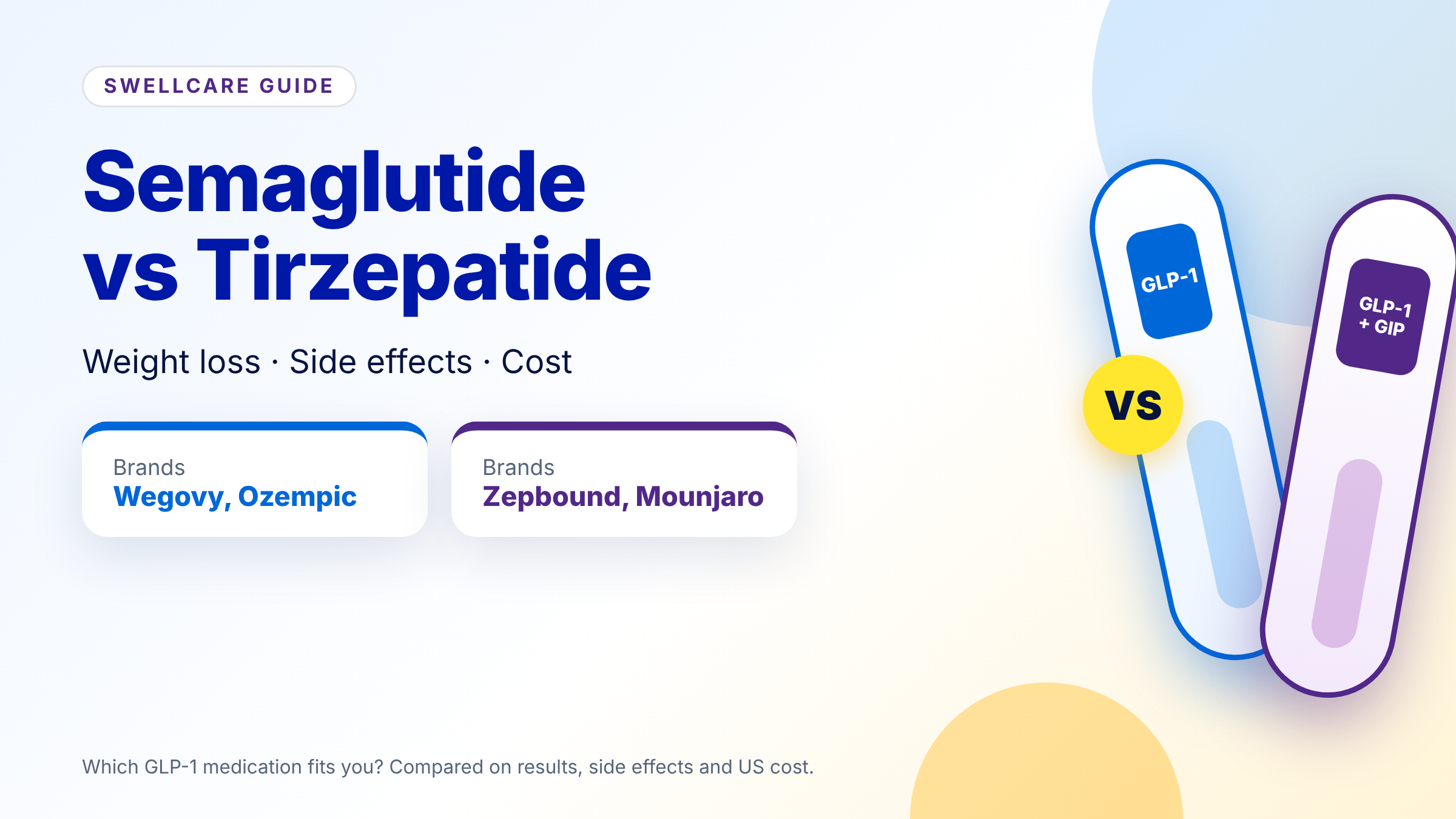
Semaglutide vs tirzepatide at a glance
| Semaglutide | Tirzepatide | |
|---|---|---|
| Weight loss brand | Wegovy (weekly injection or daily pill) | Zepbound (weekly injection) |
| Type 2 diabetes brand | Ozempic, Rybelsus | Mounjaro |
| Hormones it copies | GLP-1 | GLP-1 and GIP |
| Average loss at 72 weeks | 13.7% | 20.2% |
| Extra FDA-approved uses | Lower cardiovascular risk (heart attack and stroke) in adults with heart disease and obesity; liver disease (MASH) | Moderate to severe obstructive sleep apnea in adults with obesity |
Same drug, different label. Ozempic and Wegovy are both semaglutide. Mounjaro and Zepbound are both tirzepatide. Ozempic and Mounjaro are approved for type 2 diabetes, while Wegovy and Zepbound carry the FDA approval for weight loss, so they’re the ones most plans consider. Every drug named here counts as a GLP-1 drug in the broad sense, though only tirzepatide also hits GIP. Check the FDA label for each brand before you assume a use is covered.
How semaglutide and tirzepatide work
Both belong to the family of GLP-1 medications, drugs that borrow your body’s own gut-hormone signals. Semaglutide mimics GLP-1, a hormone that tells your brain you’re full, slows how fast your stomach empties and helps your pancreas release insulin when blood sugar climbs. That’s why GLP-1 drugs also lower blood sugar in people with type 2 diabetes. Tirzepatide copies GLP-1 and a second hormone called GIP. Researchers think GIP adds to appetite control and changes how the body handles sugar and fat.
So tirzepatide is a dual GLP-1 and GIP agonist, while semaglutide is a GLP-1 only drug. One extra hormone is the whole mechanical difference, and GIP is the likeliest reason tirzepatide tends to move the scale further. Both drugs quiet appetite, but tirzepatide seems to do it with a bit more force.
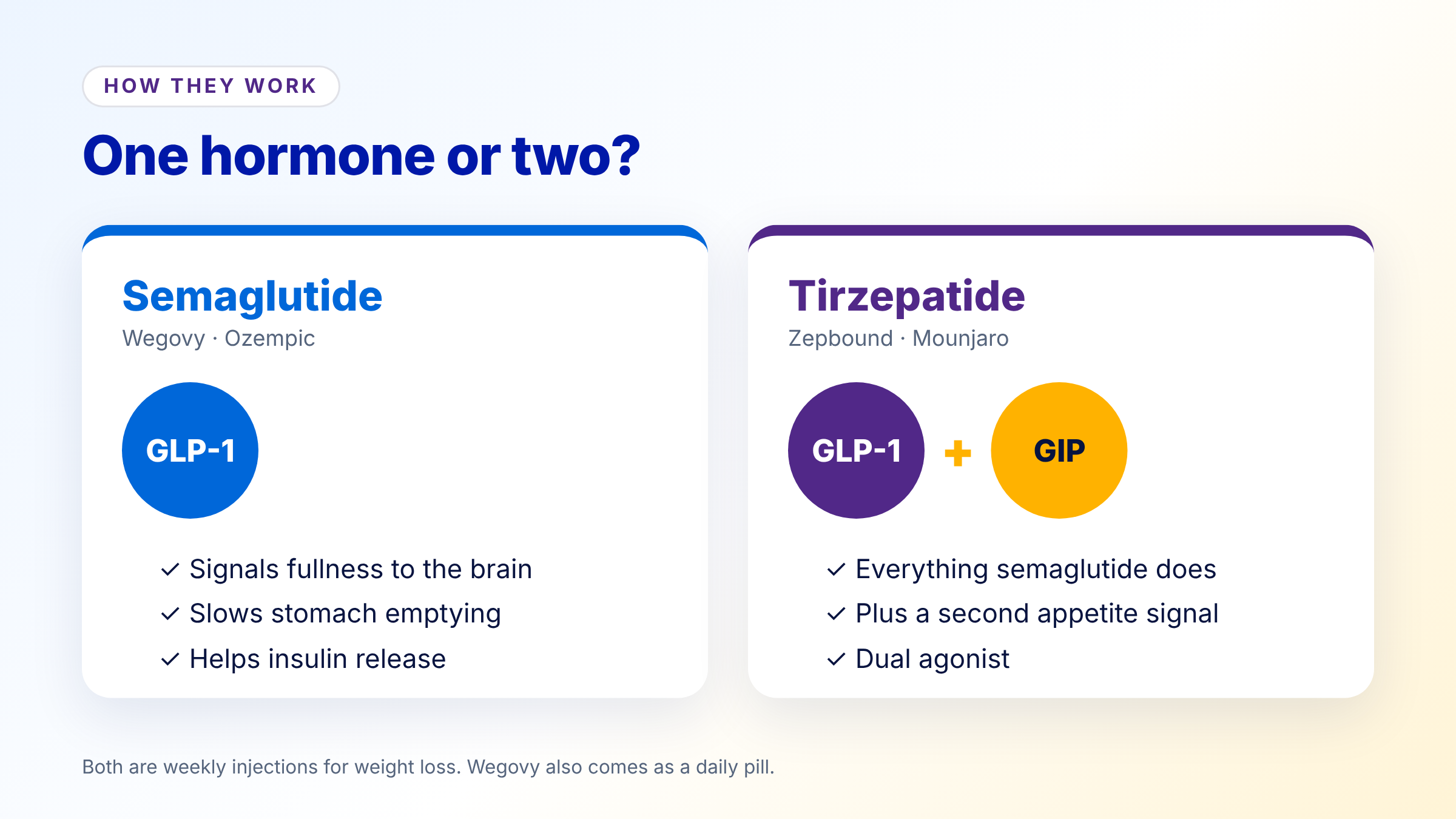
Both GLP-1 drugs are weekly injections for weight loss. Wegovy also comes as a daily pill. Both start low and climb slowly. Zepbound begins at a 2.5 mg dose for about four weeks, then steps up through 5, 7.5, 10, 12.5 and 15 mg. Wegovy builds toward a 2.4 mg maintenance dose, and the higher Wegovy HD (7.2 mg) is reserved for people who tolerated 2.4 mg for at least four weeks.
That slow climb isn’t red tape. It’s the main way to keep nausea manageable.
Dosage also drives price and side effects. A higher dose usually means more weight loss and more stomach upset, so your clinician is balancing both. If a dose isn’t tolerated, stepping back for a few weeks is normal. It isn’t failure. The dosage that works for a friend on semaglutide or tirzepatide won’t always work for you.
Weight loss results: what the head-to-head clinical trial found
This clinical trial is called SURMOUNT-5. It enrolled 751 adults with obesity but without type 2 diabetes, at 32 sites in the US and Puerto Rico, and ran 72 weeks at maximum tolerated doses. Tirzepatide users lost an average of 20.2% of body weight, about 50 pounds. Semaglutide users lost 13.7%, about 33 pounds.
About 32% of the tirzepatide group lost 25% or more of their weight, compared with roughly 16% on semaglutide, according to Weill Cornell Medicine’s summary and the published report in the New England Journal of Medicine.
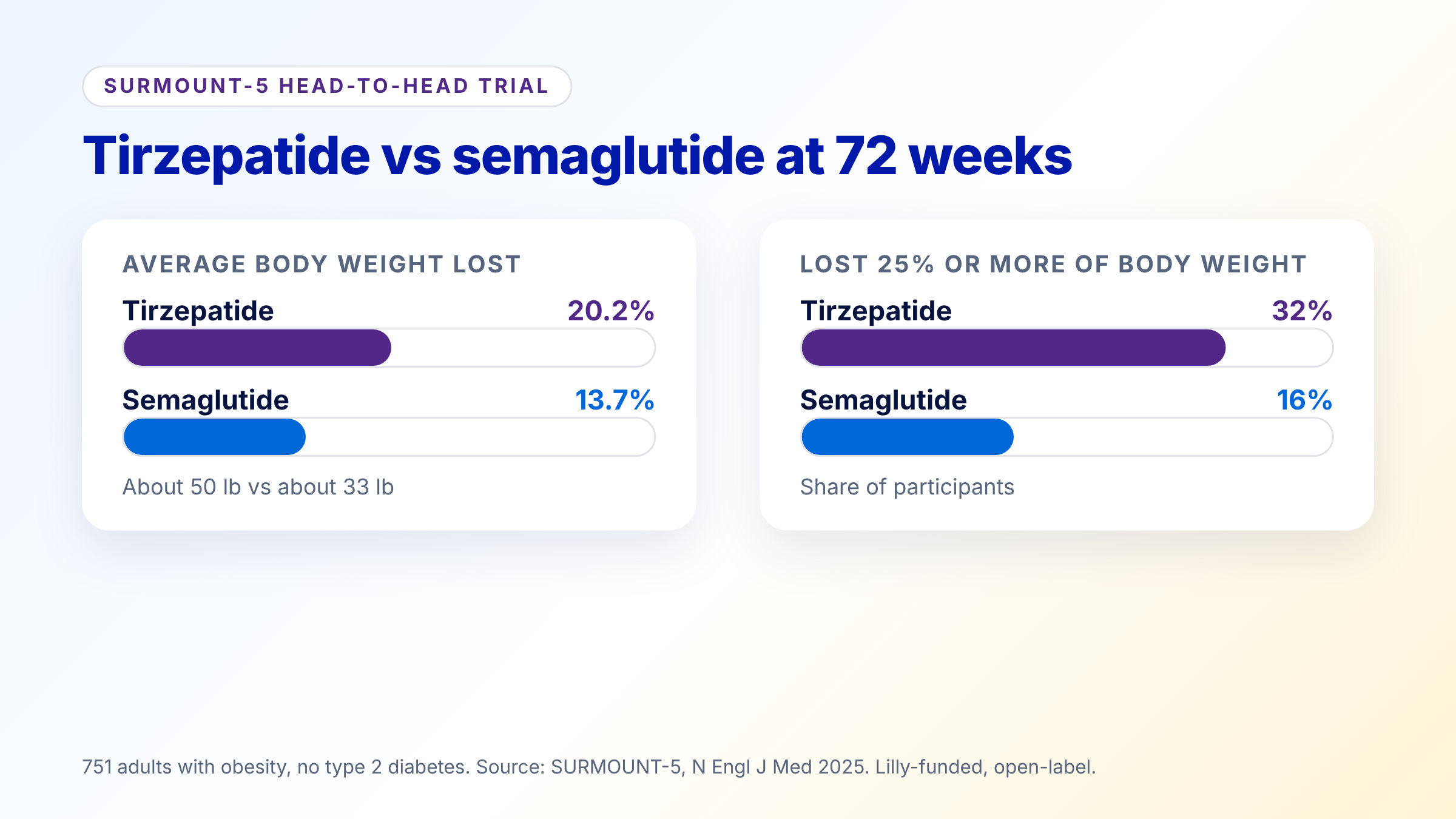
Read that clinical trial with two caveats. Lilly funded the study, and it wasn’t blinded, because the pens look different. Still, no other head-to-head clinical trial points the other way.
Averages hide a lot. Some people on semaglutide lose more than 20%. Some on tirzepatide lose far less. Your own response in the first few months tells you more than any chart. Blood pressure and blood sugar often improve too, sometimes before the scale moves much.
Two other points matter as much as the number on the scale. Weight regain is common after stopping either drug, so lifestyle changes like protein-forward meals and strength training aren’t optional extras. They protect muscle and make the results last. And the benefits go beyond weight: semaglutide has heart-protection data in people with cardiovascular disease, and tirzepatide has an approval for sleep apnea.
Semaglutide vs tirzepatide side effects
The side effects overlap almost completely. Stomach upset, diarrhea and constipation lead the list. Most are stomach-related, mild to moderate, and show up when a dose goes up.
| Side effect | What it feels like | What usually helps |
|---|---|---|
| Nausea | Queasy, especially after large meals | Smaller meals, slower eating, bland food |
| Diarrhea | Loose stools for a few days after a dose change | Fluids, less greasy food |
| Constipation | Hard, infrequent stools | Water, fiber, daily walking |
| Vomiting | Less common, often from eating too much | Stop at “pleasantly full,” call us if it persists |
In SURMOUNT-5, roughly 44% of people in both groups had nausea and about 25% had abdominal pain. Drugs.com notes that rates can’t be compared across separate trials, and tirzepatide’s stomach effects were reported more often in some of them. Fatigue, dizziness, injection-site reactions and hair loss also turn up on both the semaglutide and tirzepatide labels.
Serious risks are rare but real. Both labels carry a boxed warning, the FDA’s strongest kind, about thyroid tumors seen in rodent studies. Nobody knows yet whether the same thyroid tumors show up in people, but because of that boxed warning neither drug is used by anyone with a personal or family history of medullary thyroid carcinoma or MEN 2. Report a neck lump, hoarseness or trouble swallowing right away, since thyroid problems are what the boxed warning is about.
Pancreatitis and gallbladder problems are on both labels too. Like every GLP-1 medication, both slow stomach emptying, and the FDA added an ileus warning in 2023. One tirzepatide detail people miss: it can make birth control pills less reliable, so you add a barrier method for four weeks after starting and after each dose increase.
Cost of semaglutide vs tirzepatide in the US
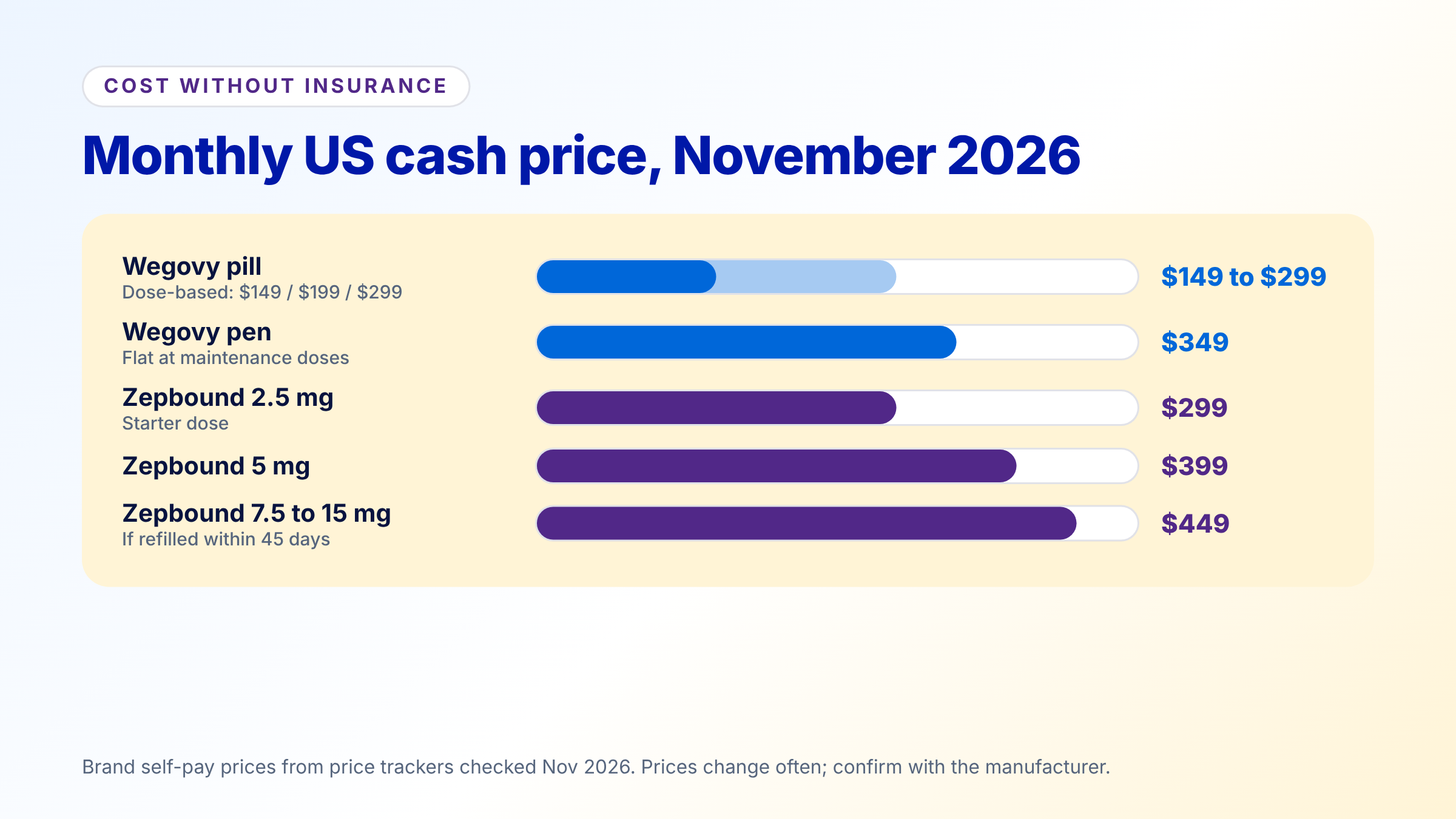
GLP-1 list prices run past $1,000 a month. Ozempic lists at about $1,028 and Zepbound at about $1,086 per 28 days. Almost nobody pays that. What matters is the cash price and your insurance, plus whether you qualify for a program. The cost of semaglutide is flat at maintenance doses, while the cost of tirzepatide climbs with each step up, so compare them at the dose you’ll actually reach.
| Option | Monthly cash price | Notes |
|---|---|---|
| Wegovy pen (NovoCare) | $349 | Flat across maintenance doses, down from $499 in November 2025 |
| Wegovy pill (NovoCare) | $149 to $299 | $149 at 1.5 mg, $199 at 4 mg, $299 at 9 mg and 25 mg |
| Zepbound 2.5 mg (LillyDirect) | $299 | Starter dose |
| Zepbound 5 mg | $399 | |
| Zepbound 7.5 to 15 mg | $449 | If you refill within 45 days; otherwise $499 or $699 |
Those figures come from price trackers checked in November 2026, including GLP Chart and Metabolic Ledger. Prices change fast, so confirm on the manufacturer’s site before you commit. Without insurance, the Wegovy pill is the cheapest brand-name way in. With insurance the numbers can drop lower still, though Zepbound’s higher tirzepatide doses usually stay pricier than Wegovy’s semaglutide.
Insurance is patchier. About 43% to 45% of commercial insurance plans covered Zepbound for weight loss as of late 2025, almost always with prior authorization, which means your doctor has to document why you need it.
Check your plan’s drug list first, and ask whether the insurance plan covers any weight loss medication at all, since many exclude them. If your insurance does cover it, the manufacturer savings card can bring the copay to $25 a month, up to $1,300 a year.
For Medicare Part D members who qualify, the GLP-1 Bridge program charges $50 a month from July 1, 2026 through December 31, 2027 for Wegovy and the Zepbound KwikPen.
A warning on the $59 offers you’ll see online. Those are usually compounded semaglutide, not the FDA-approved brand. Ask exactly what you’re getting before you pay.
Which one is right for you?
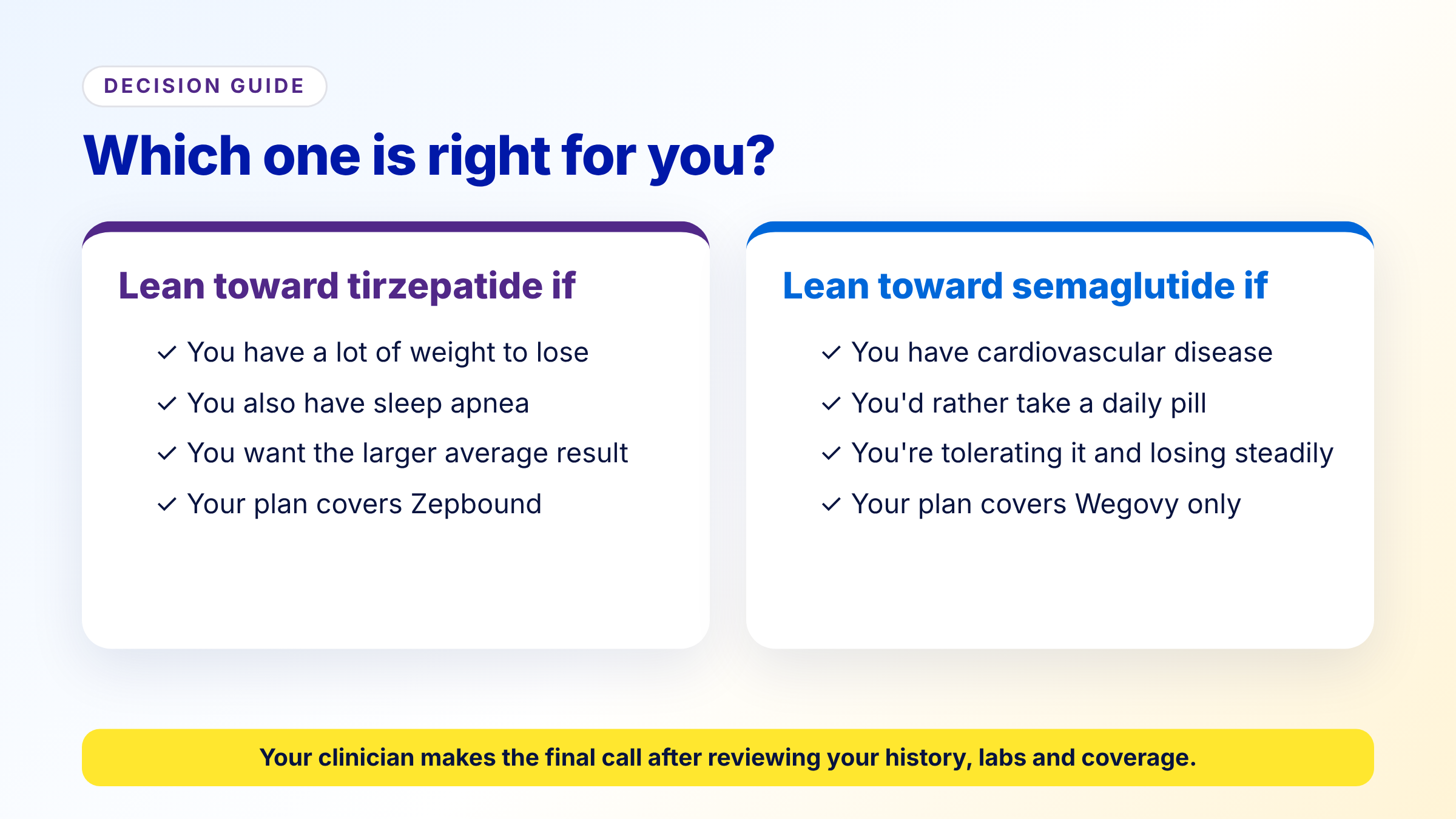
Here’s our honest take on these two GLP-1 options. If you have a lot of weight to lose, or you also have sleep apnea, tirzepatide, with its extra GIP action, is where most clinicians start. The trial gap is too big to ignore.
Semaglutide makes more sense in a few situations:
- You have cardiovascular disease and want the drug with heart-protection approval.
- You’d rather take a daily pill, and the Wegovy pill at $149 to start fits your budget.
- You tolerated semaglutide well and you’re losing steadily.
- Your plan covers Wegovy and not Zepbound. Coverage often decides this one.
Blood pressure, blood sugar, kidney health and other medications all feed into the call, which is why a quick review beats guessing from a chart.
Neither semaglutide nor tirzepatide replaces habits. Whichever you pick, the people who keep the weight off tend to pair it with lifestyle changes: steady protein and daily movement, plus some strength work. The medication lowers appetite. It doesn’t build the routine for you.
Switching from semaglutide to tirzepatide
Switching between GLP-1 drugs is common, usually after a plateau or when coverage changes. Don’t take both at once, and don’t stack one injection on top of the other. Your clinician will pick a tirzepatide starting dose based on where you are on semaglutide and how you’ve handled it, rather than starting you at the top. Tirzepatide adds GIP on top of GLP-1, so expect a short stretch of stomach side effects again, even if semaglutide treated you well. Plan the switch with your prescriber, and keep your lifestyle changes going through it, because they carry across from one drug to the other.
When to call your doctor
Call the same day for severe stomach pain that won’t ease, pain in the upper right belly, vomiting that keeps you from holding down fluids, or signs of dehydration. Those can point to pancreatitis or gallbladder trouble. Get checked quickly for a lump in your neck, trouble swallowing or hoarseness, which can signal thyroid tumors. Swelling of the face or throat, or trouble breathing, is an emergency, so call 911.
How to get started with a clinician
Choosing between these two GLP-1 drugs, semaglutide and tirzepatide, shouldn’t be a coin flip, and it shouldn’t be driven by an ad. A Swell clinician can review your history and goals, plus your coverage, then tell you which weight loss medication fits and what a safe dosage plan looks like. Start with a Swell visit and bring your current medication list.
Questions people ask about semaglutide vs tirzepatide
Is tirzepatide better than semaglutide for weight loss?
On average, yes. In the SURMOUNT-5 clinical trial, tirzepatide produced 20.2% weight loss versus 13.7% for semaglutide at 72 weeks. Better on average doesn’t mean better for you. Cost, coverage, heart history and how you tolerate each drug can flip the answer for an individual patient.
Is Zepbound the same as Mounjaro?
They’re the same medication, tirzepatide, sold under two brand names. Mounjaro is approved for type 2 diabetes. Zepbound is approved for chronic weight management and for moderate to severe obstructive sleep apnea in adults with obesity. Prices and coverage often differ between them, as do prior authorization rules.
Which has worse side effects?
They’re similar. Nausea, diarrhea, vomiting and constipation lead the list for both, and about 44% of people in each group of the head-to-head trial reported nausea. Some trials report stomach effects slightly more often with tirzepatide. A slow dose increase matters more than whether you’re on semaglutide or tirzepatide.
Can I take semaglutide and tirzepatide together?
No. They both act on GLP-1 pathways, and combining them raises the chance of severe nausea, vomiting and dehydration without a proven benefit. If one stops working for you, your clinician can switch you to the other, but you shouldn’t stack them or overlap doses on your own.
How fast will I lose weight?
Most people on a GLP-1 drug notice appetite changes within the first weeks, but meaningful weight loss builds over months as the dose climbs. In SURMOUNT-5, the full results took 72 weeks to show. Expect steady, not dramatic, progress early on, and judge the drug after you’ve reached a maintenance dose.
Do I have to stay on it forever?
Not necessarily, but be realistic. Weight regain is common after stopping either medication, because appetite signals return. Many people stay on a lower maintenance dose long term. If you want to stop, taper with your clinician and keep the eating and exercise habits you built.
Trusted references
Public-health, research, and medical-society resources related to this guide.