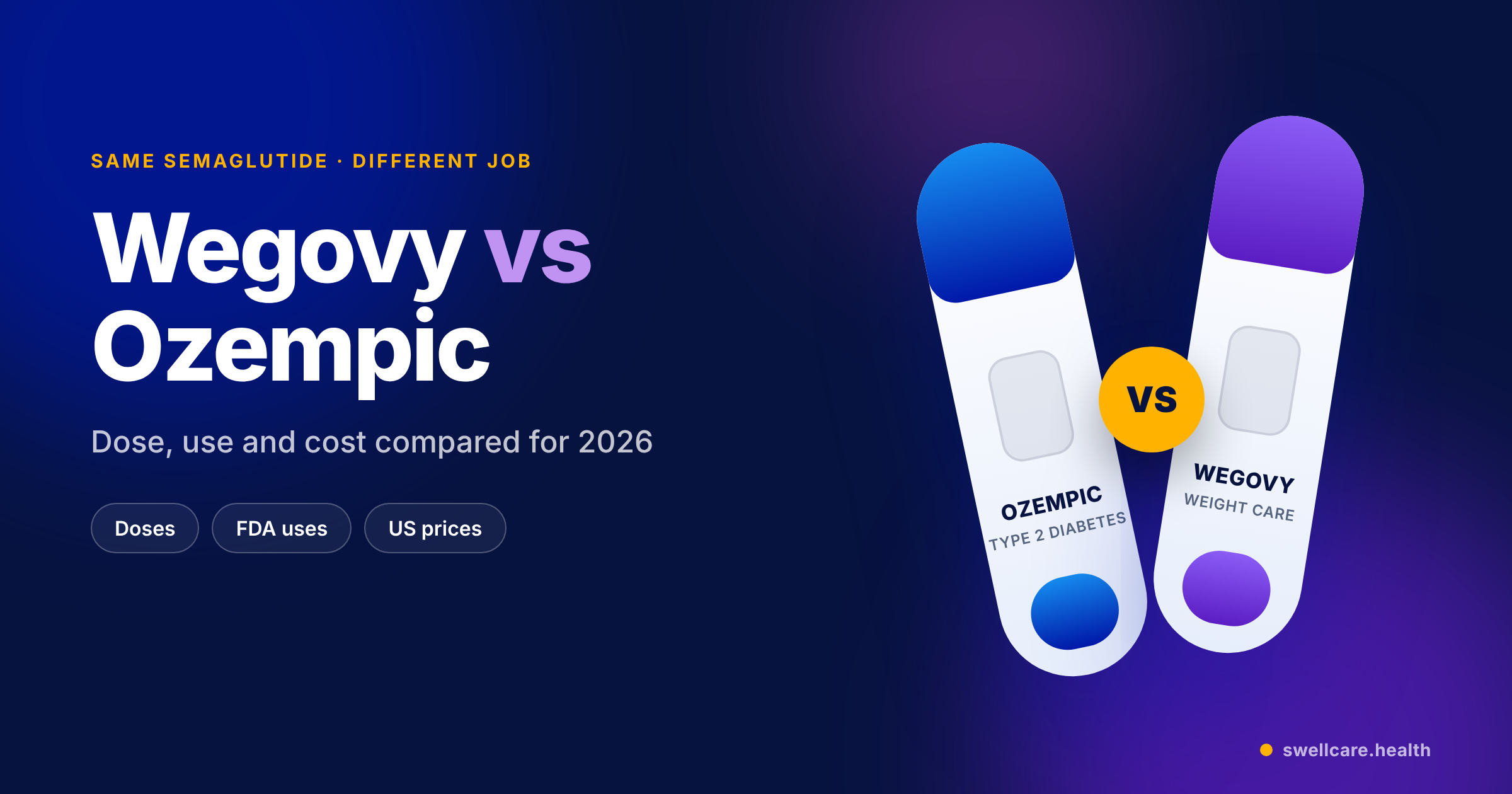
Here’s the short answer. Wegovy and Ozempic are the same medicine. Both are best known as a weekly injection of semaglutide from Novo Nordisk. What separates them is the job each one is approved for, how high the dosage goes, and how you end up paying for it.
Ozempic treats type 2 diabetes. Wegovy treats obesity and helps people keep weight off. That one difference shapes everything else in the Wegovy vs Ozempic decision: which doctor writes it, whether insurance pays, and how much weight you can expect to lose.
This guide walks through the dose schedules, the evidence, the 2026 prices and the situations where each one makes sense. It also covers when neither is the right call.
Wegovy vs Ozempic at a glance
| Ozempic | Wegovy | |
|---|---|---|
| Active ingredient | Semaglutide | Semaglutide |
| Main FDA use | Type 2 diabetes | Weight management (obesity or overweight) |
| Form | Weekly injection pen (tablet also sold) | Weekly injection pen, or a daily tablet |
| Top dosage | 2 mg a week | 2.4 mg a week (7.2 mg with the HD pen) |
| Common side effects | Nausea, diarrhea, constipation | Same, but more frequent |
| Who can use it | Adults with type 2 diabetes | Adults, plus teens 12 and up for weight loss |
| Self-pay price (2026) | $349 to $499 a month | $349 a month ($399 for HD; pill from $149) |
Same active ingredient, same maker, same weekly injection rhythm. Because the active ingredient is identical, the side effects line up too. Two knives, one piece of steel, sharpened for different work.
Same medicine, different job: what each is approved for
Semaglutide is a GLP-1 agonist. It copies GLP-1, a gut hormone that tells your brain you’re full, slows how fast your stomach empties and helps the pancreas release insulin after you eat. Turn that dial up and appetite drops. That’s why one molecule ended up with two brand names.
The FDA approves each brand for specific uses, and those labels matter. They decide what your plan covers and what your clinician can document.
What Ozempic is approved to treat
According to the Ozempic prescribing information, Ozempic is FDA-approved for adults with type 2 diabetes to:
- improve blood sugar control, alongside diet and exercise
- lower the risk of heart attack, stroke and cardiovascular death in people who already have heart disease
- lower the risk of kidney failure and cardiovascular death in people with chronic kidney disease
Weight loss isn’t on that list. Plenty of people lose weight on it anyway, but prescribing Ozempic just for weight is off-label use.
What Wegovy is approved to treat
The Wegovy label is built around chronic weight management. Wegovy is approved to help adults with obesity (a BMI of 30 or more), or overweight (a BMI of 27 or more) plus a weight-related condition like high blood pressure or high cholesterol, lose weight and keep it off. Teens 12 and older with obesity can use the injection too.
It carries two more approvals. Wegovy lowers the risk of heart attack, stroke and cardiovascular death in adults with heart disease who have obesity or overweight. And the injection treats MASH, a fatty liver disease with scarring, in adults with moderate to advanced fibrosis. (MASH was formerly called NASH.)
So Wegovy isn’t a diabetes drug, and Ozempic isn’t a weight management drug. Swapping them is sometimes sensible, but it’s off-label, and insurance often won’t pay.
Wegovy vs Ozempic dosage, step by step
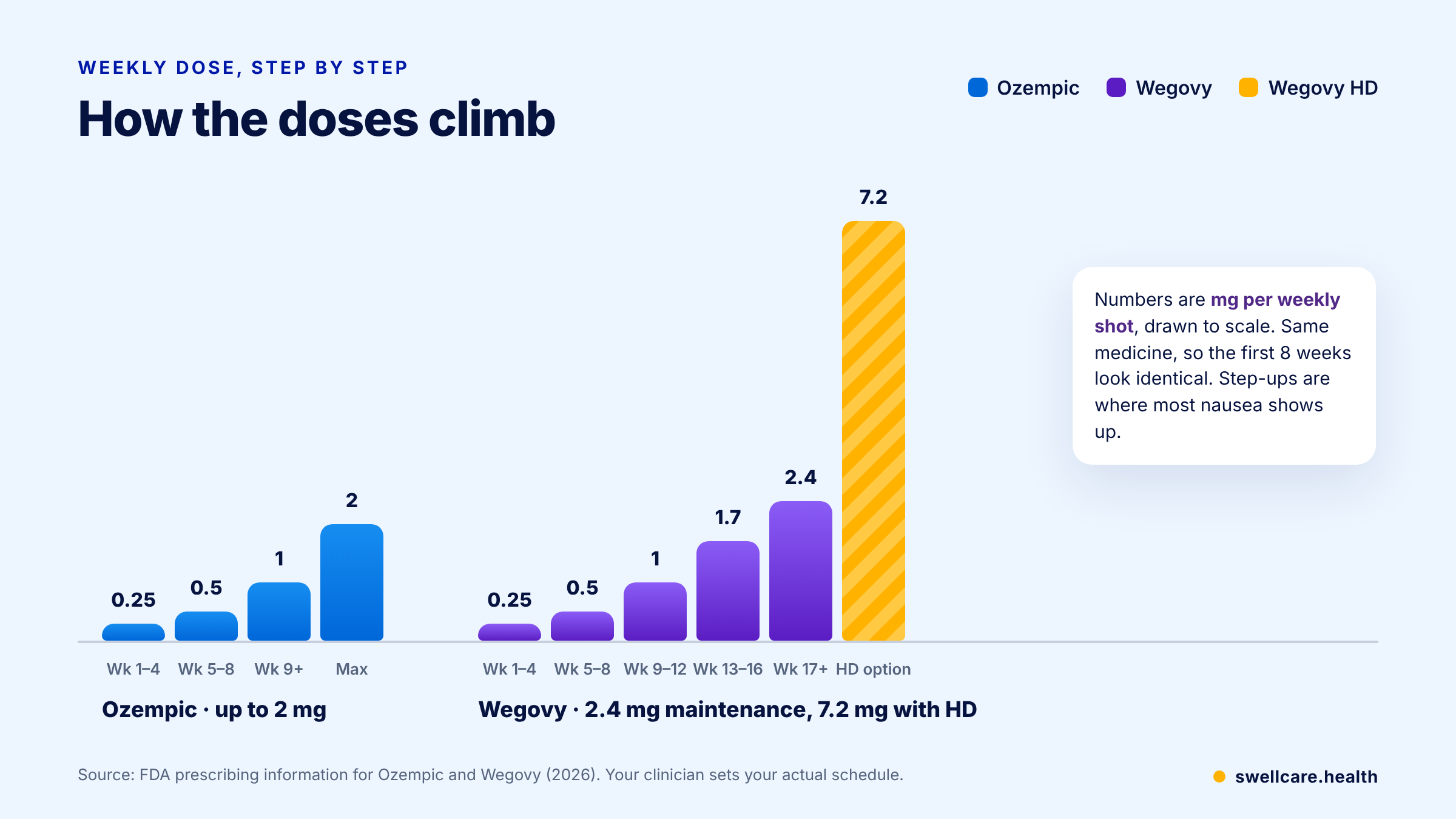
Both start low on purpose. Your gut needs time to adjust. Most gastrointestinal side effects show up during these step-ups, and rushing the climb is a common reason people quit.
| Weeks | Ozempic weekly dosage | Wegovy weekly dosage |
|---|---|---|
| 1 to 4 | 0.25 mg | 0.25 mg |
| 5 to 8 | 0.5 mg | 0.5 mg |
| 9 to 12 | 1 mg (if needed) | 1 mg |
| 13 to 16 | 2 mg (if needed, after 4+ weeks on 1 mg) | 1.7 mg |
| 17 onward | Maintenance dosage of 0.5, 1 or 2 mg | 2.4 mg maintenance dosage (or 1.7 mg) |
How Ozempic dosing works
Ozempic’s dosage follows your blood sugar, not your scale. You start at 0.25 mg for four weeks, then move to 0.5 mg. If your A1C still isn’t where it should be, it can go to 1 mg and later 2 mg, with at least four weeks at each step.
Some people stay at 0.5 mg for years. That’s fine.
A missed dose can be taken within five days. After that, skip it and take the next one on your usual day.
How Wegovy dosing works
Wegovy climbs on a fixed schedule toward a 2.4 mg maintenance dosage, reached around week 17. If 2.4 mg is too rough on your stomach, 1.7 mg is an approved option too.
Two newer options matter in 2026. Wegovy HD, a 7.2 mg weekly prefilled pen approved in March 2026, is for adults who’ve handled 2.4 mg for at least four weeks and need more weight loss. The Wegovy pill is a daily tablet that steps from 1.5 mg up to 25 mg over about three months. You take it on an empty stomach, which is a habit some people find harder than a weekly shot.
Which one leads to more weight loss?
Wegovy, and it isn’t close. Its top dose is higher, and its clinical trials were designed around weight loss.
In the STEP 1 trial, adults with overweight or obesity on Wegovy’s 2.4 mg dose lost an average of 14.9% of their body weight over 68 weeks, compared with 2.4% on placebo. About 86% lost at least 5%. For someone at 240 pounds, 15% is roughly 36 pounds.
The 7.2 mg HD pen went further. In the STEP UP trial, people who stayed on treatment averaged about 20.7% weight loss at 72 weeks.
Ozempic’s weight results come from diabetes trials. In SUSTAIN FORTE, adults with type 2 diabetes on 2 mg lost about 6.9 kg (about 15 pounds) over 40 weeks, versus 6 kg on 1 mg. Those clinical trials used different people over different timelines, so it isn’t a clean head-to-head. But the pattern holds: more GLP-1 signaling, more appetite suppression, more weight loss.
Weight loss isn’t the only win, either. In the SELECT trial of more than 17,000 adults with heart disease and overweight, the 2.4 mg dose cut heart attacks, strokes and cardiovascular deaths by 20%.
Side effects and safety warnings
With the same active ingredient, the side effects match. Wegovy just causes more of them, since you take more of it.
| Side effect | Ozempic 1 mg | Wegovy 2.4 mg |
|---|---|---|
| Nausea | 20% | 44% |
| Diarrhea | 9% | 30% |
| Vomiting | 9% | 24% |
| Constipation | 3% | 24% |
Side-effect rates come from each drug’s FDA label and from different trials, so treat them as a rough guide.
Most gastrointestinal side effects peak in the days after a step-up and then fade. Constipation can outlast nausea. Smaller meals help. So does stopping when you’re full, not when the plate is empty, and going easy on greasy food the day of your shot.
The serious warnings are the same for both:
- Thyroid tumors. Both labels carry a boxed warning. Semaglutide caused thyroid C-cell tumors in rodents. Don’t take either if you or a family member has had medullary thyroid carcinoma or MEN 2.
- Pancreatitis. Severe belly pain that spreads to your back needs urgent care.
- Gallbladder disease. Fast weight loss raises the risk of gallstones.
- Low blood sugar. This mostly happens when semaglutide is paired with insulin or a sulfonylurea.
- Kidney strain. Vomiting and diarrhea can dehydrate you, which can hurt your kidneys.
Neither drug is for use during pregnancy. Stop at least two months before you plan to conceive.
One more warning: skip the knockoffs. The FDA says compounded semaglutide isn’t FDA-approved or reviewed for safety, and the agency had logged 990 adverse event reports for compounded semaglutide by May 2026, some tied to dosing errors.
How much do Wegovy and Ozempic cost in 2026?
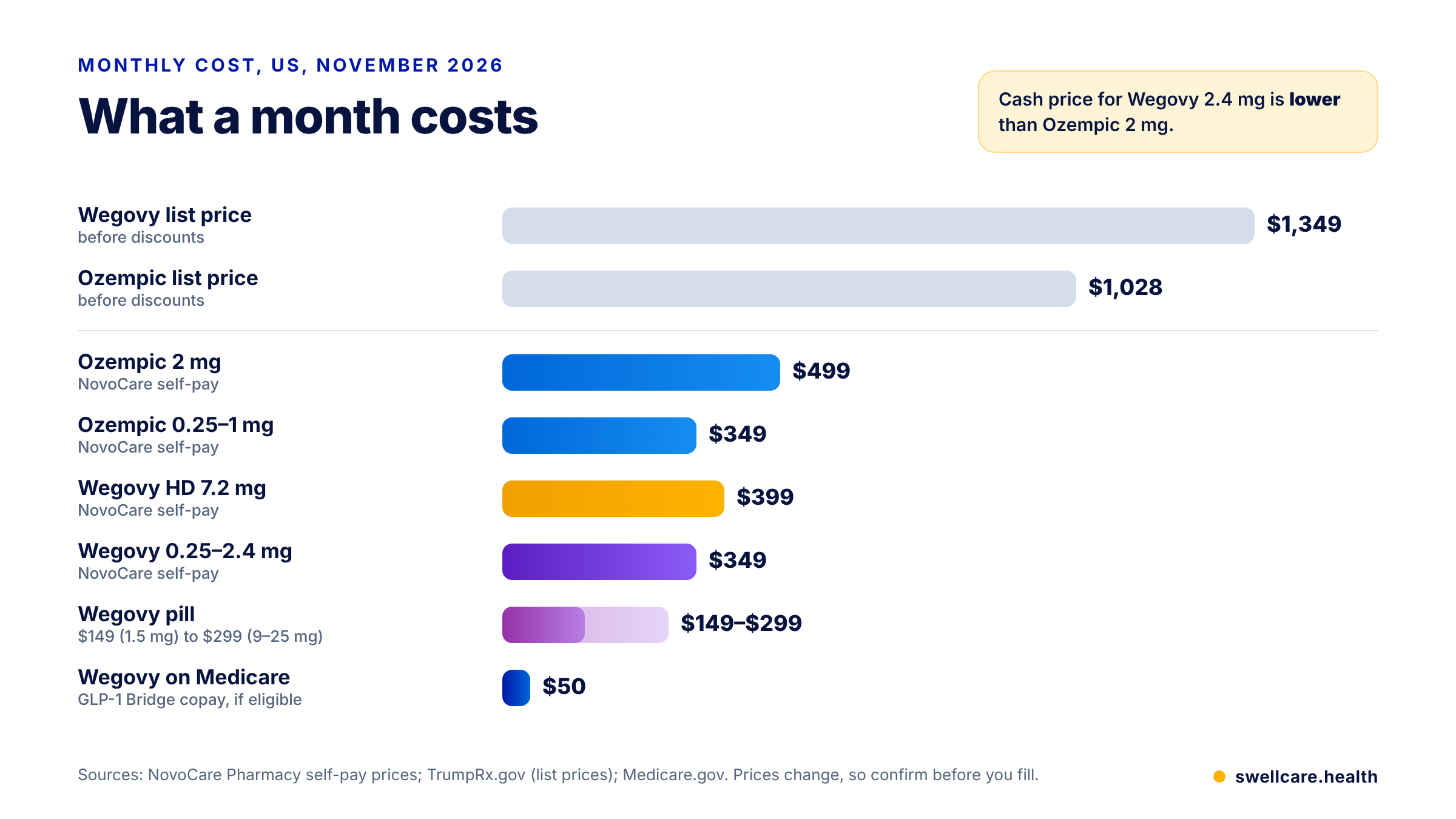
Prices dropped sharply over the past year. List prices still sit around $1,000 to $1,350 a month, but cash prices are much lower after Novo Nordisk’s 2025 pricing deal with the White House. List prices for both fall to $675 on January 1, 2027, which can trim coinsurance.
Self-pay prices
These are the NovoCare Pharmacy self-pay prices listed in November 2026:
| Product and dose | Monthly self-pay cost |
|---|---|
| Ozempic 0.25, 0.5 or 1 mg | $349 |
| Ozempic 2 mg | $499 |
| Wegovy 0.25 mg to 2.4 mg | $349 |
| Wegovy HD pen, 7.2 mg | $399 |
| Wegovy tablets, 1.5 mg / 4 mg | $149 / $199 |
| Wegovy tablets, 9 mg or 25 mg | $299 |
New self-pay patients can get the two starter doses of either pen for $199 a month for their first two fills, through December 31, 2026. Prices can change, so check before you fill.
Here’s what most comparisons miss: paying cash, Wegovy at 2.4 mg costs less than Ozempic at 2 mg. If weight loss is your goal and no plan is paying, there’s little reason to chase Ozempic.
Insurance and Medicare coverage
Coverage is where the two split hardest. Ozempic is a diabetes drug, so most commercial plans and Medicare Part D cover it for type 2 diabetes, usually with a copay. With commercial insurance, Novo’s savings card can bring the cost down to as little as $25 a month.
Wegovy coverage depends on your employer’s plan. Many plans exclude weight management drugs entirely. The ones that cover Wegovy usually want prior authorization showing your BMI and health conditions, such as high blood pressure or sleep apnea.
Medicare changed in 2026. Through the temporary Medicare GLP-1 Bridge, which started July 1, 2026, people with Part D who meet BMI and health criteria can get Wegovy for a $50 monthly copay. Ozempic isn’t part of it. People with type 2 diabetes don’t qualify for the Bridge, because their regular Part D coverage already handles diabetes drugs.
Can you switch from Ozempic to Wegovy?
Yes, and it’s common. Someone who started Ozempic purely for weight often moves to Wegovy once coverage or cost lines up. Since the active ingredient is the same, your clinician usually doesn’t restart you at the bottom. They match your current weekly dosage and keep climbing from there.
Don’t run both at once, though. You’d be doubling up on semaglutide and stacking the side effects for no added benefit.
Which one is right for you?
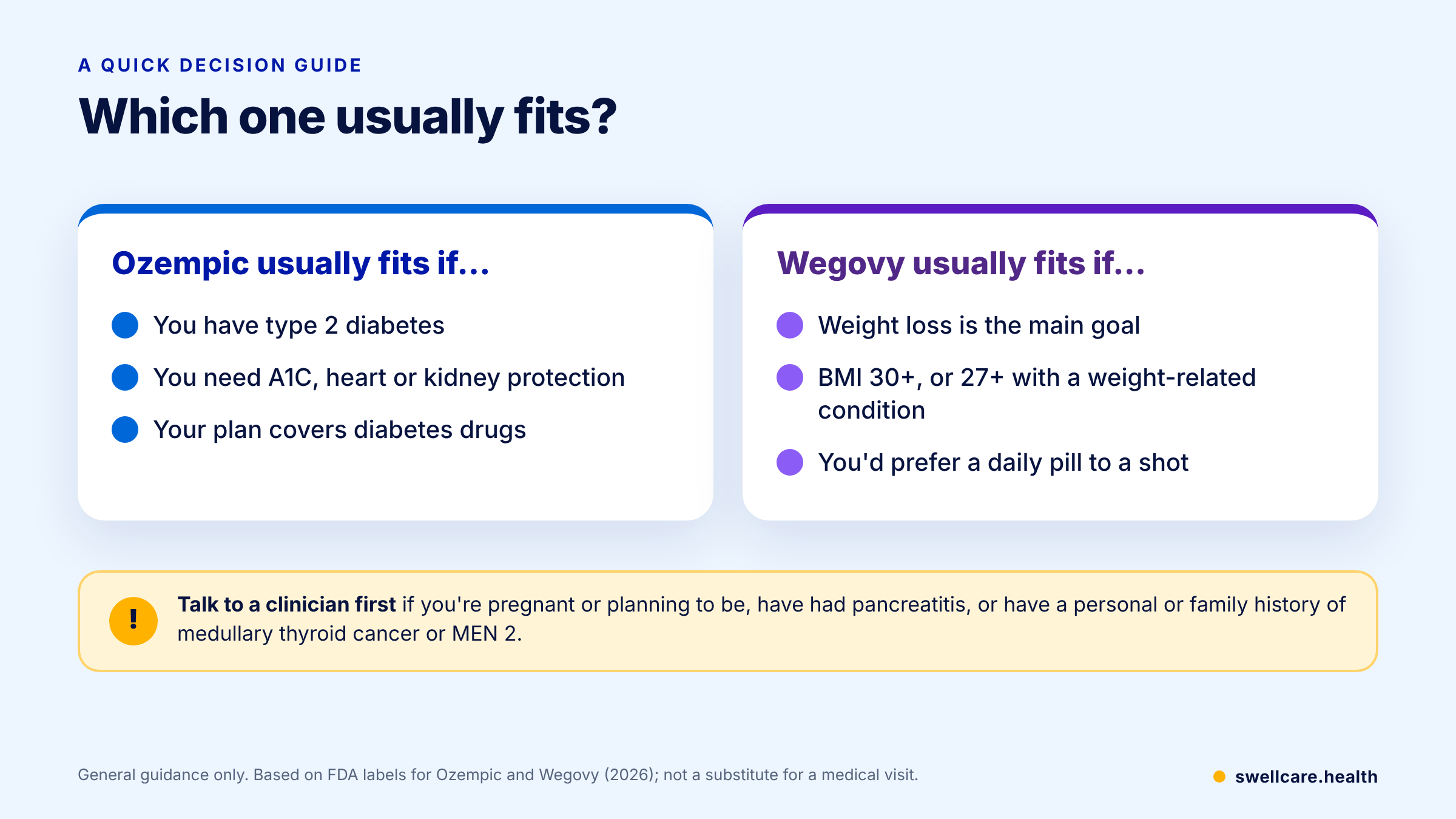
Your situation usually makes the choice for you.
You have type 2 diabetes. Ozempic is the natural fit. It lowers your A1C, protects your heart and kidneys, and it’s the one your plan is most likely to cover. You’ll probably lose weight too.
You don’t have diabetes and want to lose weight. Wegovy is built for this. It has the higher ceiling, the weight-loss data and the weight management label your plan looks for.
You have heart disease and carry extra weight. Wegovy has the proven heart benefit for people without diabetes.
You hate needles. Ask about the Wegovy pill instead of a weekly injection. It’s daily, and the empty-stomach rule takes some getting used to.
Neither may fit if you’re pregnant or trying to be, have a personal or family history of medullary thyroid cancer, or have had pancreatitis. A clinician should talk you through other options first.
When to call a doctor
Get help right away if you have severe belly pain that won’t let up, pain spreading to your back, vomiting that stops you keeping fluids down, a lump or swelling in your neck, trouble swallowing, or signs of an allergic reaction. If you take insulin, call about shakiness, sweating or confusion, which can mean low blood sugar.
For milder side effects, like an upset stomach or constipation that lasts more than a week after a step-up, talk to your prescriber before the next shot.
Getting started with MeltOff at Swell Medical
Medication can help, but it isn’t the whole plan. That’s the idea behind MeltOff, Swell Medical’s clinician-led weight care program created by Dr. Laura Purdy, MD, MBA.
You start with a free screening chat. If it makes sense, a clinician reviews your health history, goals and budget in a $45 consultation, and talks through Wegovy, Ozempic or other options. A prescription is never guaranteed, and medication and lab costs are separate. What you do get is a plan built for real life, including the plateaus and restarts.
Start your free MeltOff intake or see how Swell visits and pricing work.
Questions people ask about Wegovy vs Ozempic
Is Wegovy stronger than Ozempic?
Wegovy goes higher. Its usual maintenance dosage is 2.4 mg a week, and Wegovy HD reaches 7.2 mg, while Ozempic tops out at 2 mg. The medicine inside is identical, so milligram for milligram they’re equal. More drug usually means more appetite control and more weight loss, along with more side effects.
Can I take Ozempic for weight loss without diabetes?
A doctor can prescribe it off-label, but it’s rarely the best path. Ozempic isn’t approved for weight loss, so insurance usually won’t cover it for that, and its top dose is lower than Wegovy’s. For most people without diabetes, Wegovy is the better-matched choice, and in 2026 its self-pay price is the same or lower.
Which is cheaper, Wegovy or Ozempic?
With insurance, Ozempic is usually cheaper for people with type 2 diabetes because plans cover it. Paying cash in 2026, they cost about the same: $349 a month for most strengths through NovoCare. Ozempic 2 mg is $499; Wegovy tablets start at $149.
Can you take Wegovy and Ozempic together?
No. Both contain semaglutide, the same GLP-1 agonist, so taking them together doubles your dose and raises the risk of serious nausea, vomiting, dehydration and low blood sugar. If you’re switching, your clinician will stop one and start the other at a matching dose.
Do you have to stay on Wegovy or Ozempic forever?
Not necessarily, but many people regain much of the weight after stopping, because appetite comes back. Clinical trials of semaglutide treat obesity as a long-term condition, and many people stay on a maintenance dose for years. If you want to stop, plan it with your clinician and put habits in place first. For diabetes, stopping Ozempic usually means another medicine has to take its place.
Trusted references
Public-health, research, and medical-society resources related to this guide.
- FDA: Ozempic prescribing information (2026 label)
- FDA: Wegovy label (2026)
- Novo Nordisk: FDA approves Wegovy HD 7.2 mg injection
- American College of Cardiology: STEP 1 trial summary
- PubMed: Semaglutide trial (PMID 34293304)
- Cleveland Clinic Newsroom: SELECT trial, semaglutide and cardiovascular events (2023)
- FDA: Concerns about unapproved GLP-1 drugs used for weight loss
- The White House: TrumpRx.gov launch (February 2026)
- Becker’s Hospital Review: Novo Nordisk to lower list price of Wegovy and Ozempic in 2027
- NovoCare Pharmacy
- Novo Nordisk: Ozempic price guide (PDF)
- Medicare.gov: Weight loss drugs and the GLP-1 Bridge