You’ve been dabbing on cream for a couple of weeks. The rash is still there, still itching, and maybe angrier than when it started. Jock itch not going away is one of the most common reasons people ask a clinician about a groin rash, and it nearly always has a fixable cause.
The short answer: the wrong cream, a course that ended too soon, a fungus that keeps getting fed by moisture or your own feet, or a skin problem that was never jock itch. Below, you’ll see how to tell which one fits you, what to change this week, and when it’s time for a professional look.
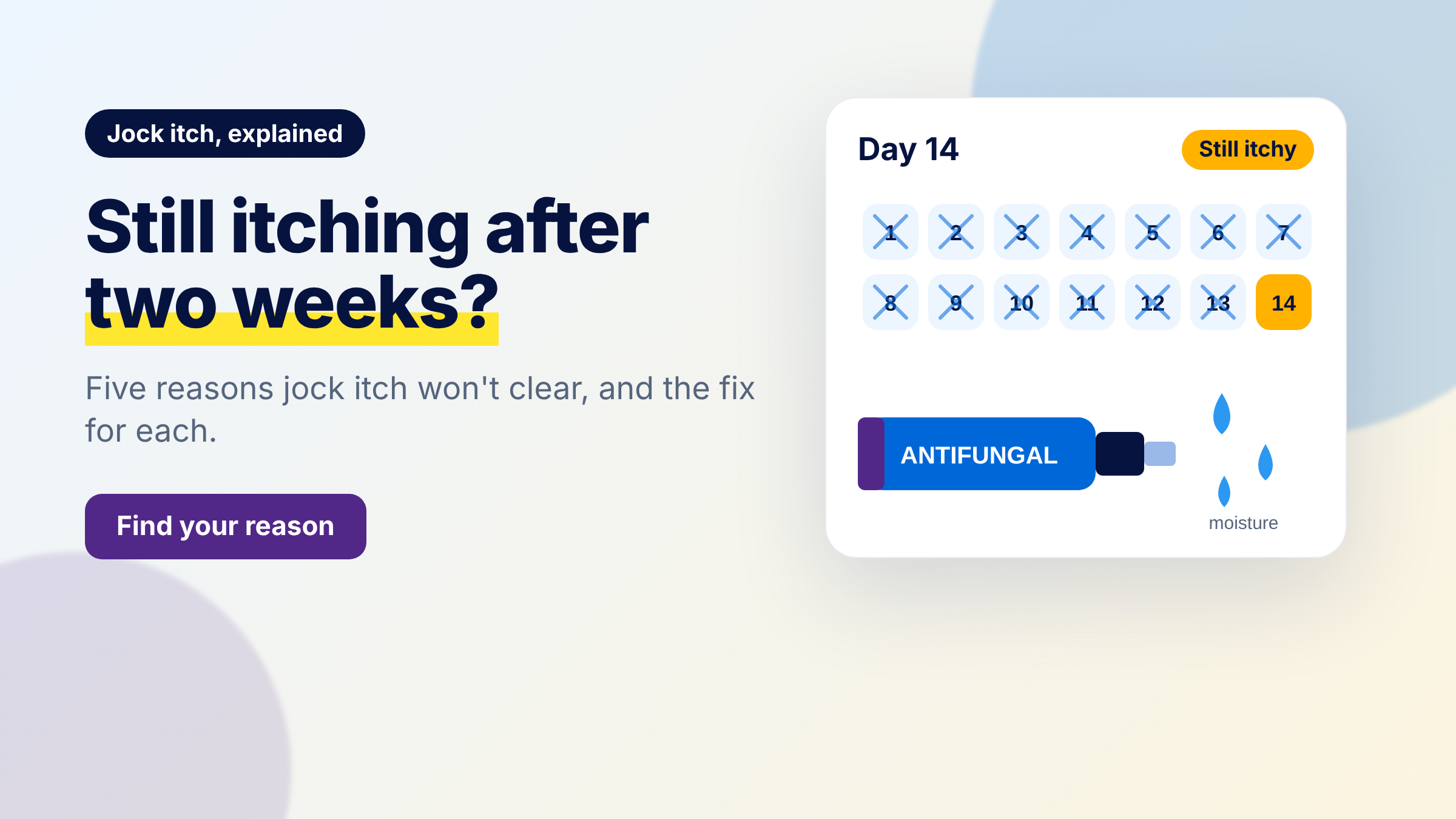
Why your jock itch is not going away
Jock itch, or tinea cruris, is a fungal infection of the groin and inner thighs. It’s a type of ringworm, according to the CDC. With the right treatment, MedlinePlus says most people improve within a couple of weeks. When yours doesn’t, one of five things is usually behind it.
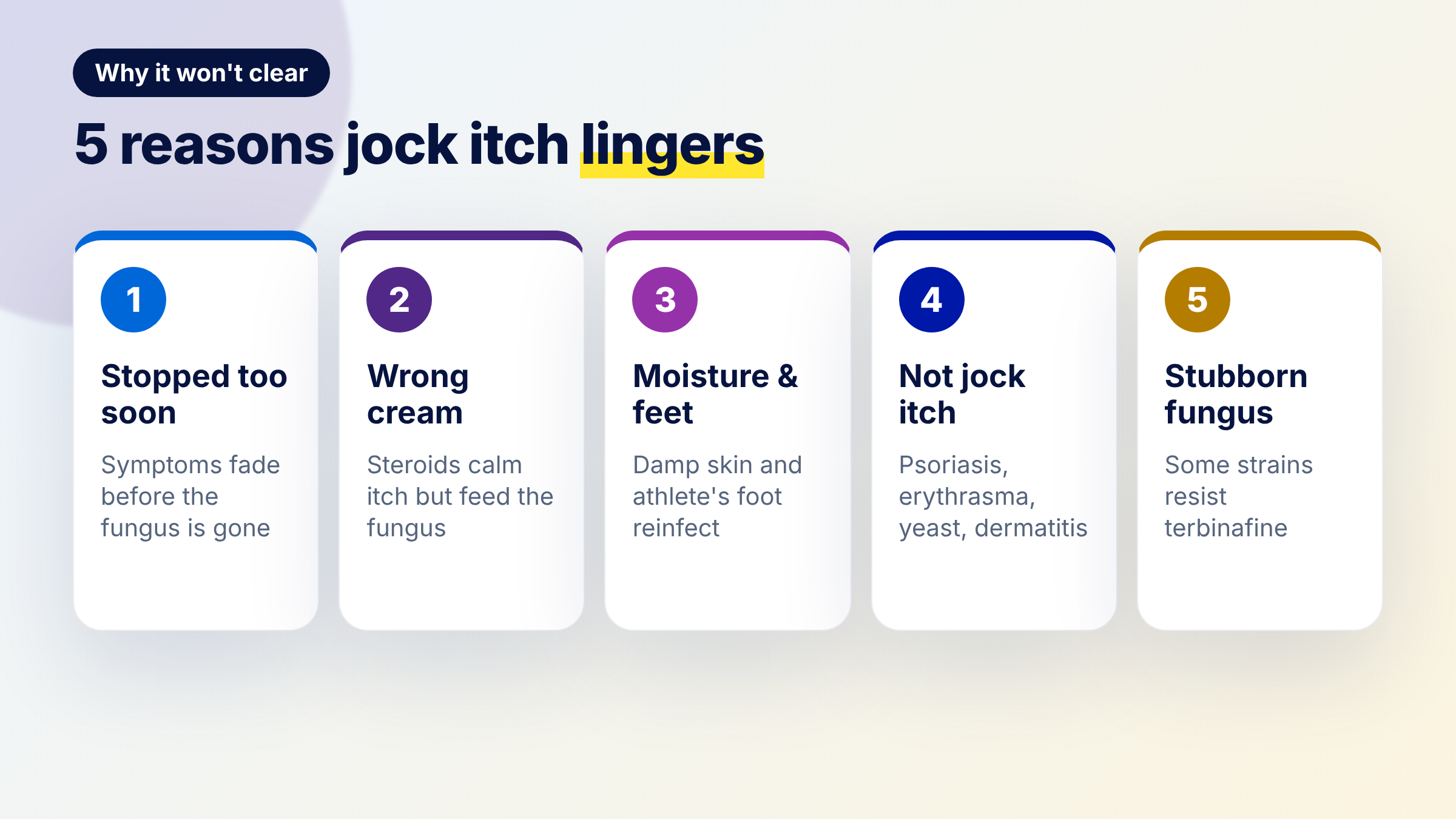
You stopped treating it too soon
The symptoms ease first: the itching fades and the redness flattens. You decide the jock itch is over and put the antifungal away.
But the fungus lives in the top layer of skin and can outlast the symptoms by days, so treatment ends before the infection does. Stop early and it rebounds, often a week later, often in the exact same spot.
The cream is the wrong one
This is the big one. A hydrocortisone cream or a steroid combination product calms itching fast, so it feels like it’s working. Meanwhile the fungal infection keeps growing.
The CDC warns that corticosteroid creams can make ringworm worse. DermNet describes tinea incognito, a fungal rash whose look has been altered by steroid use, so it’s harder to recognize and slow to respond to treatment. Check the label. If the active ingredient is hydrocortisone or “anti-itch” rather than clotrimazole, miconazole, terbinafine or butenafine, that may be your answer.
Moisture, friction and your feet keep reinfecting you
Fungal infections thrive in warm, damp skin. Sweating through gym shorts, sitting in a wet swimsuit, or wearing tight clothing all trap moisture against the groin, which is exactly what the infection wants.
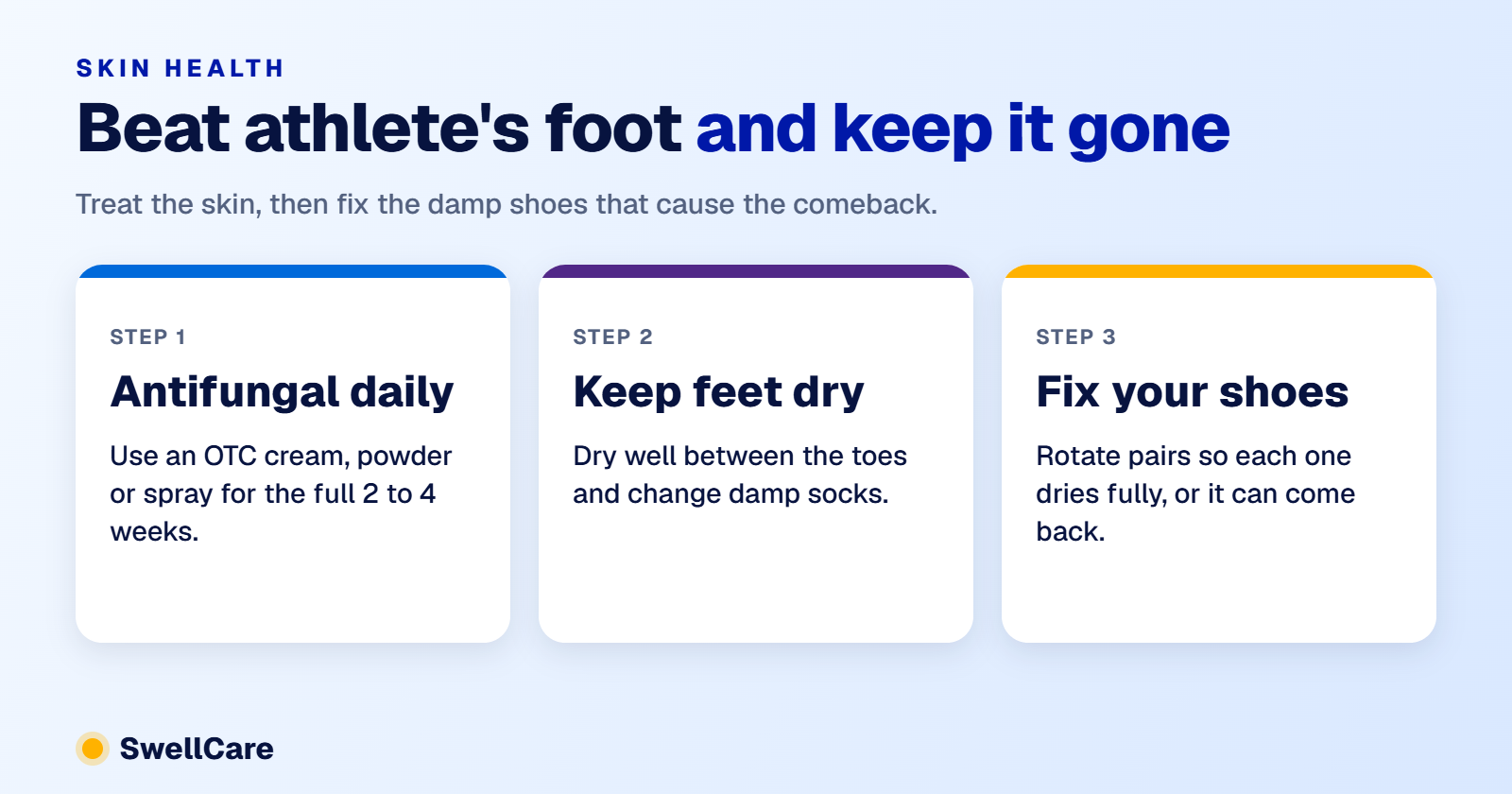
Then there are your feet. Athlete’s foot is a fungal infection from the same family, and it can spread to your groin when you pull underwear over your toes. If your feet itch or peel, you may be treating only half the problem. A shared or reused towel can spread it all over again.
It may not be jock itch at all
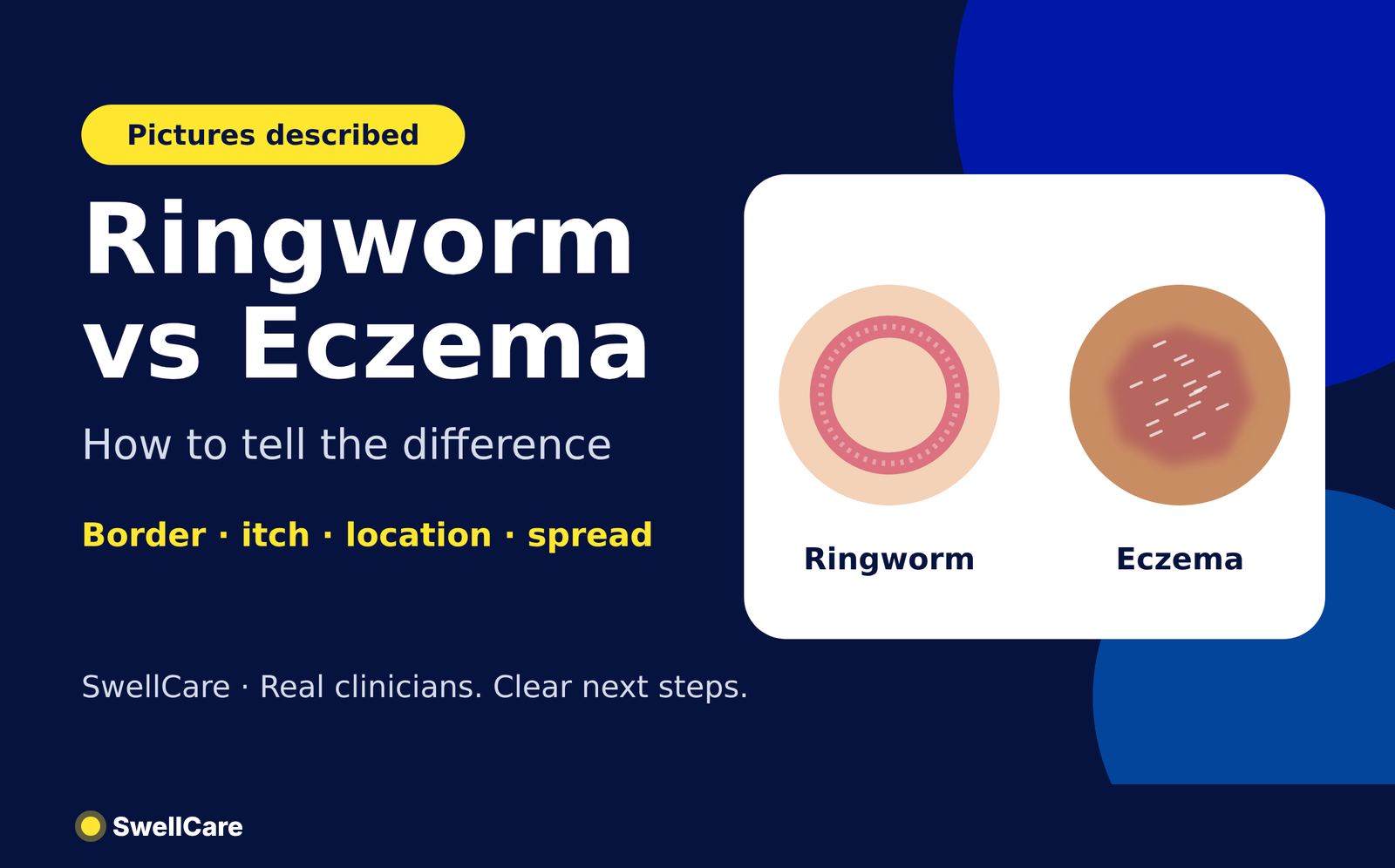
Ringworm is often confused with psoriasis and eczema. In the groin, the usual lookalikes are inverse psoriasis, which tends to look smooth and shiny rather than scaly; erythrasma, a bacterial infection that doesn’t respond to antifungal medicine; a yeast infection; and plain contact dermatitis from detergent or wipes. Psoriasis flares and erythrasma both mimic jock itch symptoms closely, and inverse psoriasis hides in skin folds, which is why it’s so often mistaken for jock itch.
One clue: jock itch usually spares the scrotum, according to MedlinePlus. If yours doesn’t, ask about a different cause.
The fungus is stubborn
Some fungal strains resist common treatment. A research letter in Emerging Infectious Diseases reviewed 157 cases of a newer fungus, Trichophyton indotineae, in the United Kingdom. About 43% involved the groin, buttock or thigh area, and roughly three in four tested samples showed reduced sensitivity to terbinafine. The CDC calls antimicrobial-resistant ringworm an emerging concern.
It’s an uncommon fungal strain, and that data is from the UK. But if a full course of terbinafine did nothing, say so when you talk to a clinician.
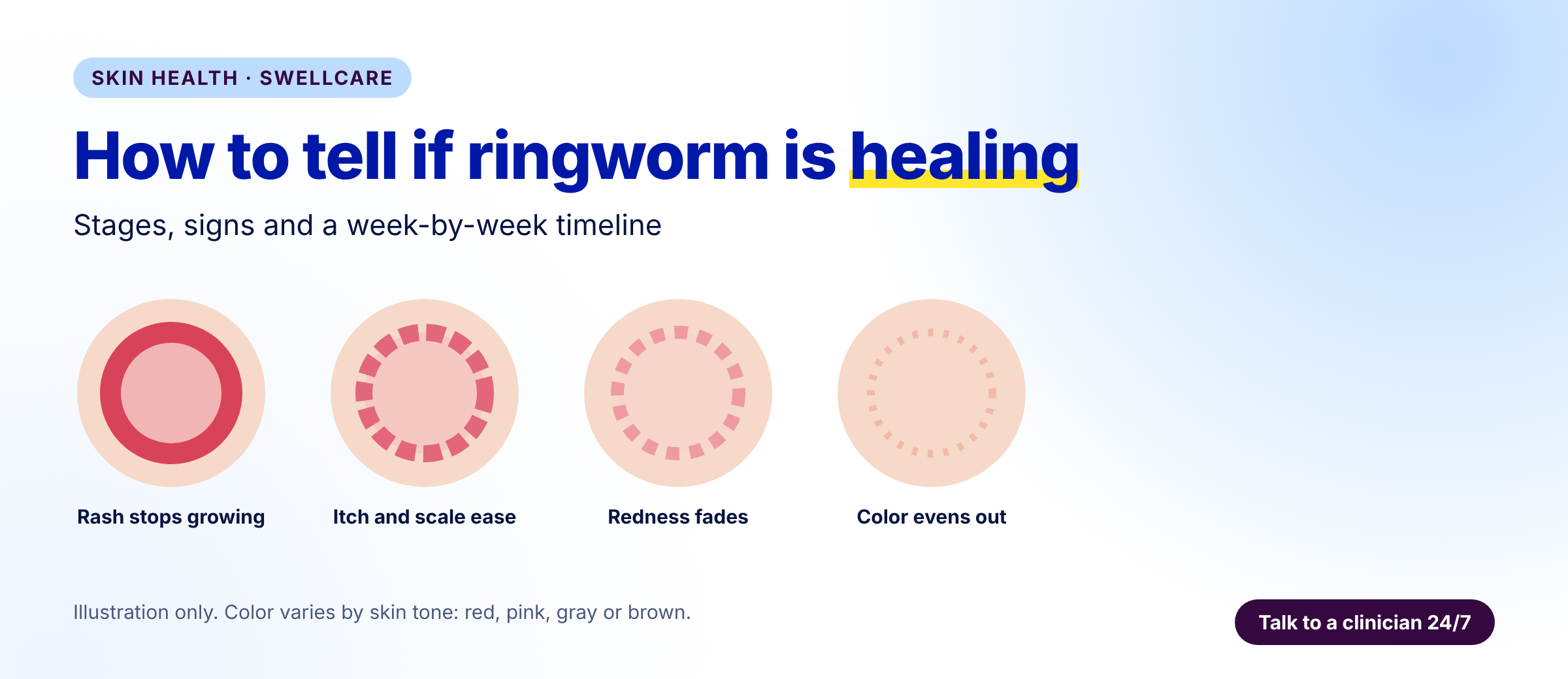
What healing should look like, week by week
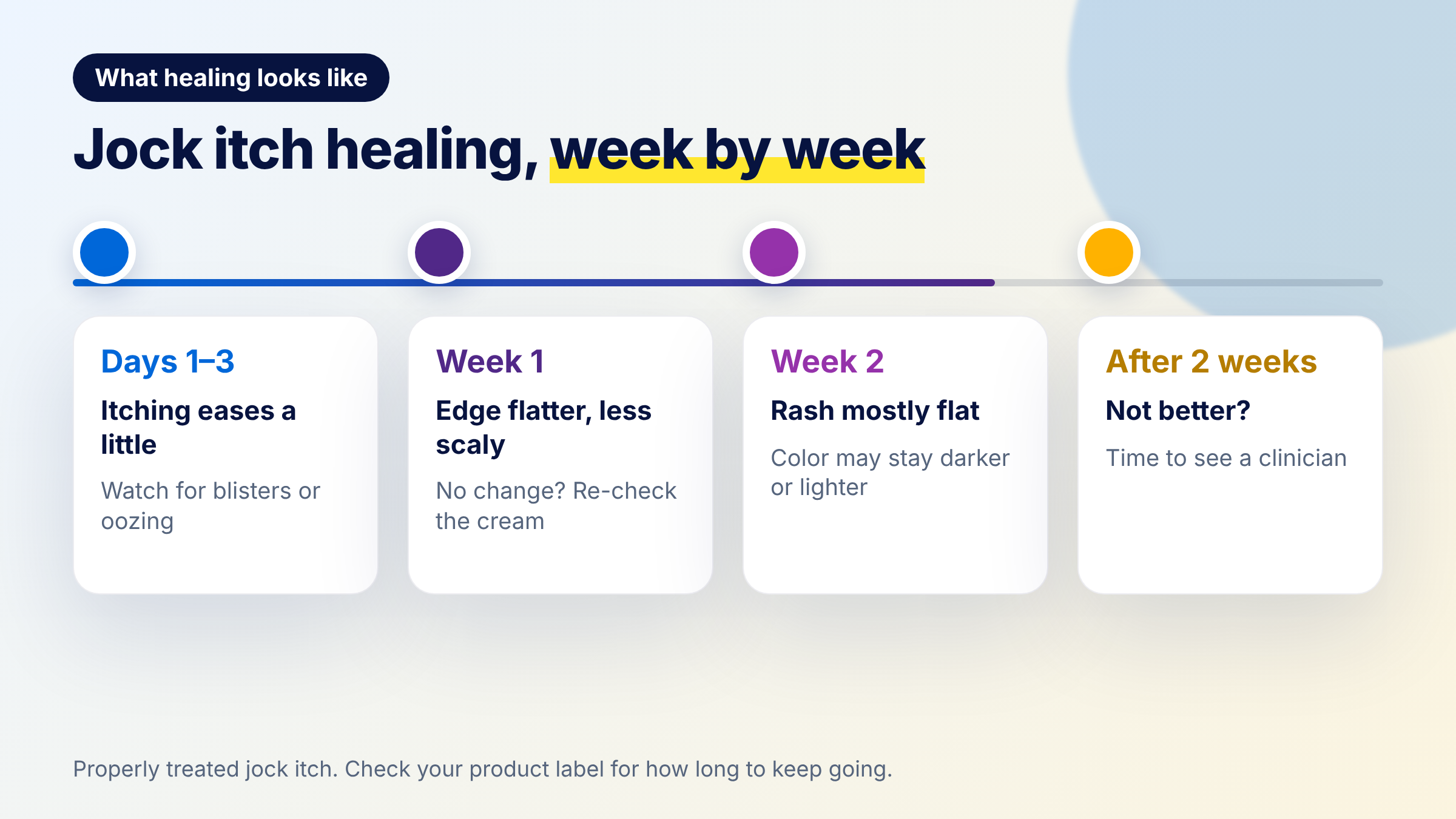
Most people want to know whether their symptoms are normal. Here’s a realistic yardstick for a properly treated case of tinea cruris.
| When | Normal progress | Red flag |
|---|---|---|
| Days 1 to 3 | Itching eases a little; redness looks about the same | Burning, blisters, oozing, or a patch that’s starting to spread |
| Week 1 | Edge is less raised and less scaly; itching clearly better | No change at all |
| Week 2 | Groin rash mostly flat; skin may look darker or lighter | Still red, scaly or itchy |
| Past two weeks | Mild color change only | Time to get it looked at |
A darker or lighter patch can hang around after the fungus is gone. That’s not a failed treatment.
How to treat jock itch that won’t clear up
Start with the basics before you assume something exotic. Most stubborn jock itch improves once treatment is corrected and these three habits are fixed.
Use the antifungal the right way
Switch to a true over-the-counter (OTC) antifungal cream or powder. Wash the groin, pat it fully dry, and apply a thin layer to the affected skin plus a little of the skin around it. Follow the label for how long to keep going, and don’t quit the day the skin looks normal. Many people add a week of insurance past that point; check your product’s directions.
Use powder by day to stay dry. Powder alone is rarely enough for an active infection.
Pick one product. Layering three different creams just irritates the skin.
Treat your feet and wash what touches the area
If you have any athlete’s foot, treat it at the same time. Put your underwear on before your socks so foot fungus can’t ride upward.
Wash underwear, towels and gym clothes after every use. Don’t share towels, because they carry and spread fungus between people. Boring? Yes. But hygiene habits like these are exactly what keep a stubborn infection from coming back.
Keep the groin dry and stop scratching
Pat dry. Then give the skin a few minutes to air out before you get dressed. Loose clothing helps, and so does changing out of sweaty clothing quickly. If you’re sweating a lot, carry a spare pair. A little OTC antifungal powder in the morning can absorb moisture during the day.
Scratching breaks skin and lets bacteria in, which can turn a simple rash into cellulitis.
What not to do
Skip hydrocortisone on jock itch. Skip rubbing alcohol too; rubbing alcohol stings and dries skin without clearing the infection. Tea tree and other essential oils are popular online, but reliable evidence is thin, and essential oils can irritate skin that’s already inflamed. No essential oil has been shown to beat a proper antifungal.
When to see a doctor about jock itch that won’t go away
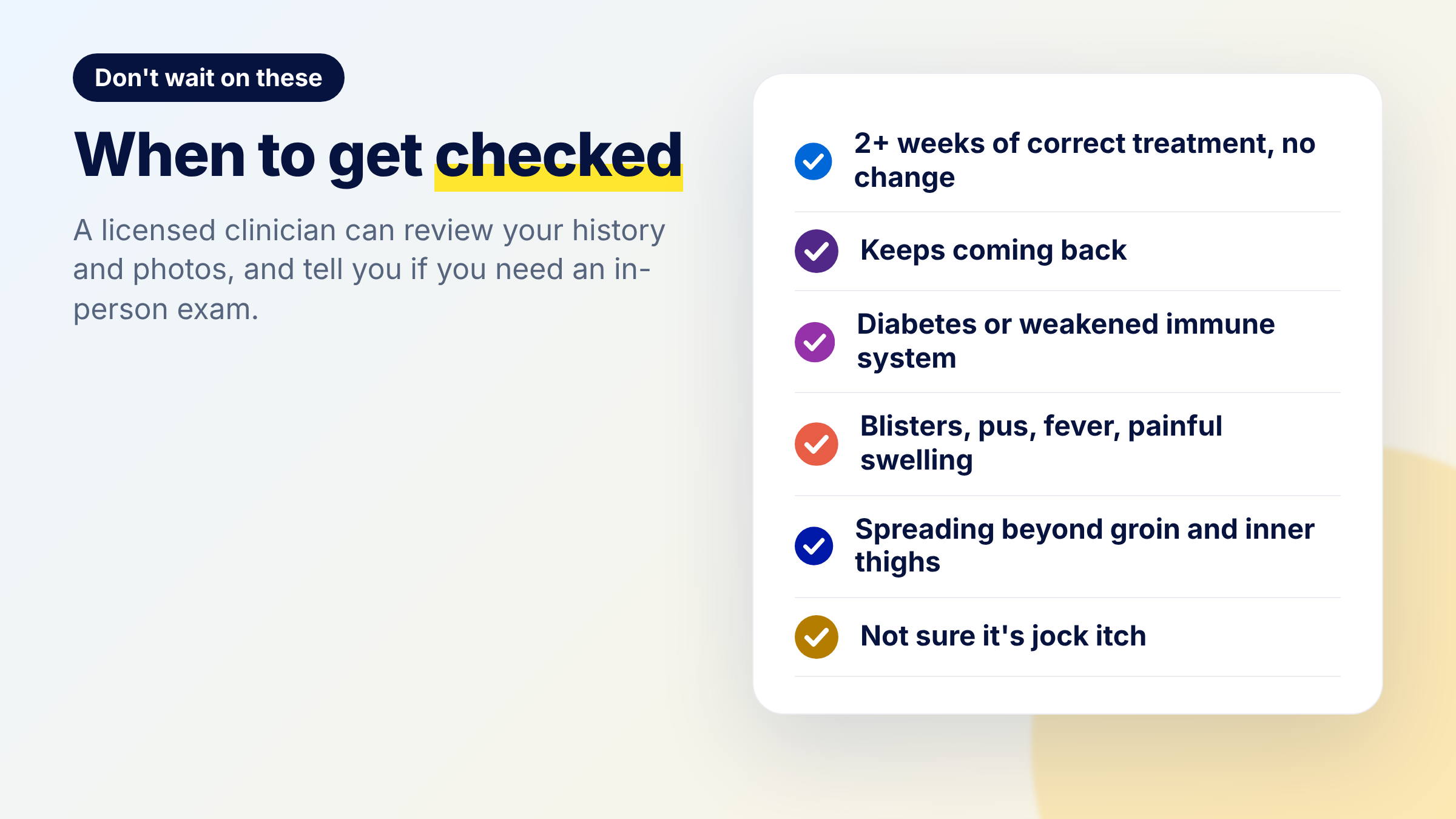
Dealing with jock itch not going away? Don’t wait on these:
- No improvement after two weeks of correct OTC treatment, which is also the MedlinePlus cutoff.
- The rash keeps coming back.
- You have diabetes or a weakened immune system, since your body clears fungus less easily.
- Blisters, pus, fever, or painful swelling, symptoms that can signal a bacterial infection like cellulitis. Get seen the same day.
- It has spread beyond the groin and inner thighs.
- Someone in your household has the same itching, a sign it’s contagious and has spread from one person to another.
- You aren’t sure it’s jock itch. A primary care clinician or dermatologist can tell.
What a clinician does when treatment has failed
Tinea cruris is often diagnosed by appearance alone. A good exam starts with a look at the skin and your history, including every product you’ve tried. If the picture is unclear, a clinician may scrape a little skin for a KOH test, which shows fungal elements under a microscope, or send a culture. MedlinePlus lists both.
From there, treatment might mean a stronger prescription antifungal such as ketoconazole, an oral antifungal, or an antibiotic if bacteria are involved. Often it means stopping a steroid cream first. A dermatologist is worth seeing if it’s widespread or keeps relapsing, and a dermatologist can sort out jock itch from its lookalikes.
At Swell, a licensed clinician can review your history and photos online and tell you whether it can be handled virtually or needs an in-person exam. Be aware that a virtual visit can’t scrape skin for testing. If that’s what you need, we’ll say so rather than guess.
How to keep jock itch from coming back
Hygiene is most of the battle. Dry thoroughly after showers and workouts. Change out of damp clothing within the hour. Keep treating feet. Wear breathable boxers or briefs, and use a powder if you’re prone to sweating. Because jock itch is contagious, don’t share towels or athletic gear, and wash your own gym gear after each wear.
If it returns more than once or twice a year, ask a dermatologist to look for a trigger such as skin folds, diabetes or a resistant strain.
Questions people ask about jock itch that won’t go away
How long should jock itch take to go away?
With the right antifungal, most people see clear improvement in symptoms within one to two weeks, and the skin often looks normal within a few. If you’re past two weeks with little change, that’s your signal to switch approach or get it examined.
Can jock itch last for months?
Yes, when it’s treated with the wrong product, stopped too early, or reinfected from feet or towels. It can also be a resistant fungus or a different rash entirely. Jock itch not going away after months is never something to just tolerate, and a dermatologist can sort out the cause.
Should I use hydrocortisone on jock itch?
No. It may ease itching briefly, but it can feed the fungus and change how the rash looks, which makes diagnosis harder. Use an antifungal designed for jock itch instead, and let a clinician decide whether a steroid is ever appropriate.
Why does jock itch keep coming back?
Usually because something keeps feeding it: damp clothing, untreated athlete’s foot, shared towels, or stopping treatment early. Skin folds and a weakened immune system can make recurrence more likely. So can damp clothing from heavy sweating. Fix the source and the rash stops returning.
Is jock itch contagious?
Yes. It can spread through skin-to-skin contact and shared items like clothing and bedding. Wash them separately, avoid sharing, and finish treatment before returning to close contact. Wash your hands after touching the rash so it doesn’t spread to your feet or other skin.
Trusted references
Public-health, research, and medical-society resources related to this guide.