Day three. Your nose is running like a faucet, your throat feels sanded down, and you’re wondering if this thing will ever end.
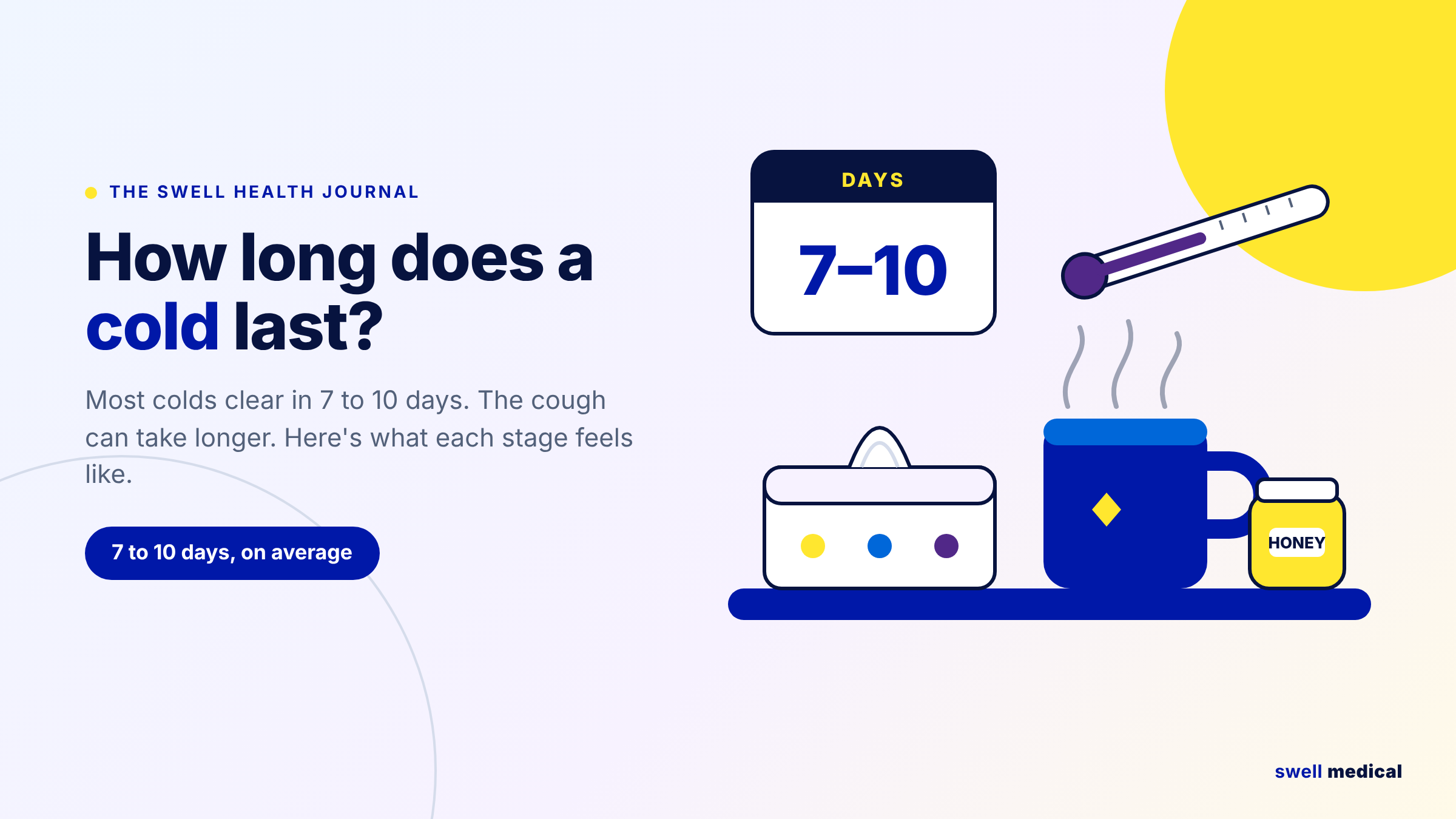
It will. So, how long does a cold last? For most adults, about 7 to 10 days, according to the Mayo Clinic. The worst of it usually lands in the first two or three days. The annoying part is the coughing, which can outstay everything else by a week or two.
Below you’ll find what each day tends to look like, why some colds drag on, what helps (and what’s a waste of money) and the specific signs that mean it’s time to talk to a clinician.
How long does a cold last? The short answer
Most colds run their course in a week to ten days, and the common cold rarely causes lasting trouble in healthy adults. The CDC notes that symptoms usually peak within 2 to 3 days of infection, and many colds are mostly gone in under a week. Adults in the US average two to three colds a year, and children often get more.
The common cold isn’t one virus. More than 200 respiratory viruses can cause it, and rhinovirus is the most frequent culprit. Others include common human coronaviruses, adenoviruses and parainfluenza viruses.
That’s part of why one cold flattens you for days while the next barely slows you down, and why the answer to how long does a cold last is a range, not a single number.
Here’s how long individual cold symptoms usually hang around:
| Symptom | When it shows up | How long it usually lasts |
|---|---|---|
| Sore throat | Often the first sign | 1 to 3 days |
| Sneezing and runny nose | Days 1 to 3 | Eases by day 7 to 10 |
| Stuffy nose and congestion | Builds by day 2 or 3 | 5 to 10 days |
| Fatigue and mild headache | Early | Usually lifts within a week |
| Fever | Uncommon in adults | 1 to 3 days if it appears |
| Cough | Often mid-cold | Can linger 2 to 3 weeks |
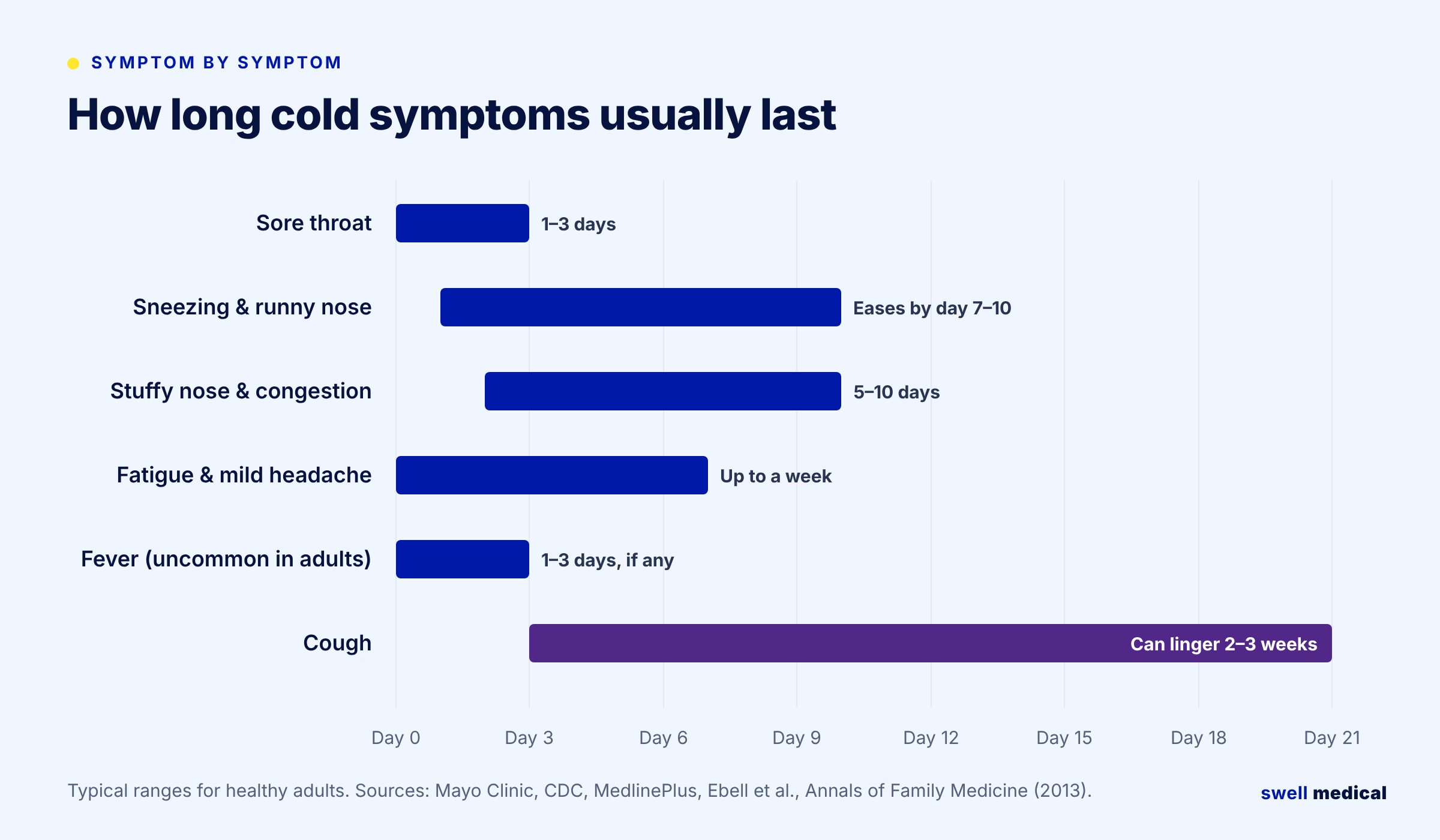
Think of it this way. If your throat, nose and energy are slowly improving and your symptoms are trending down, your cold is following the script, even if the hacking hasn’t stopped.
The stages of a cold, day by day
Doctors don’t agree on an exact number of stages. Some describe three, others five. Four stages of a cold match what people actually feel.
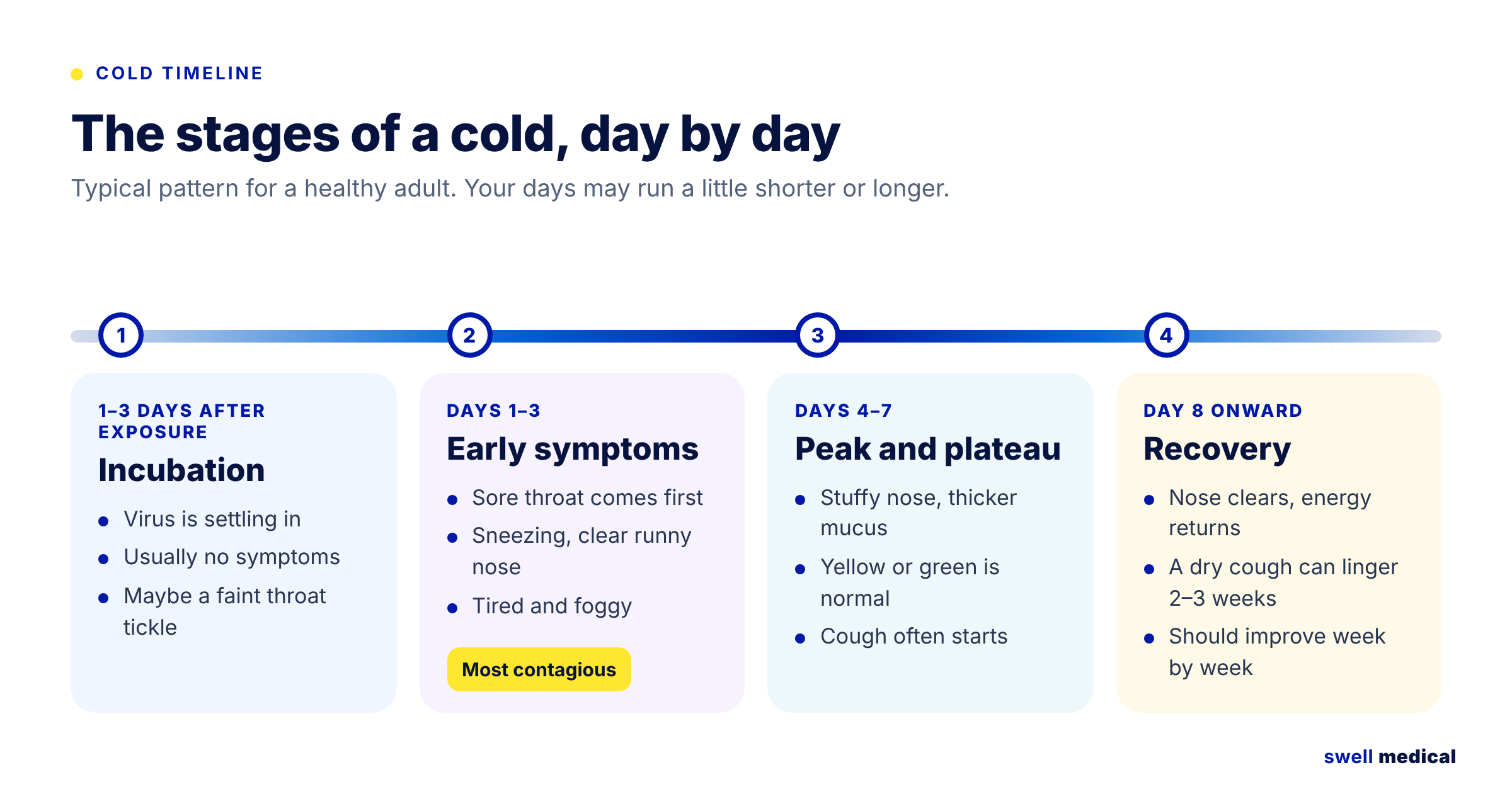
Stage 1: Incubation (1 to 3 days after exposure)
You’ve caught the virus but don’t know it yet. The incubation period is usually 1 to 3 days for a rhinovirus cold, though MedlinePlus says symptoms can take up to a week to appear. You may feel completely normal, with no symptoms at all. Some people notice a faint scratch in the throat the night before everything starts.
Stage 2: Early symptoms (days 1 to 3)
This is the “oh no” phase. A sore throat usually leads, followed by sneezing, a runny nose with clear, watery mucus, and the heavy, foggy fatigue that makes the couch look great. Cold symptoms ramp up fast and tend to hit their worst around day 2 or 3.
It’s also when you’re most likely to pass the virus on.
Stage 3: Peak and plateau (days 4 to 7)
The sore throat usually fades, but nasal congestion moves in and the runny nose may turn into a stuffed one. Mucus gets thicker and may turn yellow or green. That color change is a normal part of your immune system’s response, not proof of a bacterial infection, and MedlinePlus is clear it isn’t a reason for antibiotics. Coughing often starts here as nasal drainage trickles down the back of your throat. Fatigue can stick around too, along with the general achiness of fighting a virus.
Stage 4: Recovery and the lingering cough (day 8 onward)
Most cold symptoms ease, your nose clears and your energy comes back. The coughing, though, can hang on. A review of studies in the Annals of Family Medicine found that acute cough illness lasts 17.8 days on average, while most people surveyed expected it to be gone in about a week. That gap is why so many people assume something’s wrong in week two.
A dry, tickly post-viral cough that’s slowly getting milder is normal. Your airways are still irritated after the infection clears.
How long is a cold contagious?
You’re most contagious in the first 2 to 3 days of symptoms, and a cold usually isn’t contagious after the first week, per MedlinePlus. You can also spread the virus a day or so before you feel sick, which is why colds move through offices and classrooms so efficiently.
The virus travels in droplets when someone sneezes or coughs nearby, and on hands and surfaces. Good hygiene is your best defense. A few habits cut the spread:
- Wash your hands often, especially after blowing your nose.
- Sneeze into a tissue or your elbow.
- Stay home during the first few days, when you’re sneezing the most.
- Don’t share cups, towels or utensils.
Most people can head back to work or school once they’re feeling well enough to function, even if some mild coughing remains.
Why some colds drag on longer
Some colds stick around past day 10 even when nothing serious is going on. When people ask how long their own cold will last, these are usually the factors that tip the answer longer:
Your immune system is stretched. Poor sleep, stress, a chronic illness or medicines that suppress immunity can slow recovery.
You smoke or vape. The Mayo Clinic notes cold symptoms can last longer in people who smoke. Smoke keeps irritating airways that are trying to heal.
Asthma or another lung condition. The common cold is a frequent trigger for asthma flares, which can stretch out coughing and wheezing.
Back-to-back colds. Young children, parents of young children and teachers often catch a second virus before the first one fully clears. It feels like one endless cold.
A complication. Sometimes a cold turns into a sinus infection, an ear infection, bronchitis or even pneumonia. These usually show up as symptoms that get worse after a week, not just slow to leave. If facial pressure is the main problem, the guide to sinus headache vs migraine can help you sort out what’s going on.
Children’s colds can take a little longer to clear than adults’, and their symptoms can look different, with a low fever more likely early on. They catch more colds overall because their immune systems haven’t met as many viruses yet.
What helps a cold go away faster (and what doesn’t)
Nothing cures the common cold. Your body clears the virus on its own schedule. You can make that week easier, though, and a couple of things may trim a day or two.
What helps you feel better:
Rest and fluids. Drinking plenty of fluids, such as water, broth and warm tea, keeps mucus thin and helps prevent dehydration. Rest matters too. Sleep is when your immune system does much of its work, and pushing through fatigue only makes the week feel longer.
Honey for a cough. Federal health guidance lists honey for soothing an irritated throat. Never give honey to babies under 1 year old.
Saline spray, steam and a humidifier. A clean humidifier or a hot shower loosens congestion. Saline drops help kids, too.
Over-the-counter medicines for adults. Pain relievers such as acetaminophen or ibuprofen ease throat pain, a headache and a temperature. Decongestants can open a stuffy nose for a few days. If you have high blood pressure, ask a pharmacist before using oral decongestants. Read labels, since many combination medications double up on ingredients.
What might shorten it:
Zinc is the one supplement with a real, if debated, case. A 2024 Cochrane review found zinc may cut cold duration by about two days but called the evidence too uncertain to recommend it. Researchers who have studied zinc lozenges argue that zinc acetate lozenges, started within the first day, shorten adult colds by roughly a third. If you try them, start early and expect a metallic taste.
What doesn’t help:
Antibiotics. They don’t work on viruses and won’t help a cold. They can cause side effects and make future infections harder to treat. You’d only need them if a secondary bacterial infection, like bacterial pneumonia, develops.
Megadoses of vitamin C once you’re sick. The research hasn’t shown that starting vitamin C after symptoms begin makes much difference to how long the virus hangs around.
Cold medicines for young kids. The CDC says over-the-counter cough and cold products aren’t recommended for children under 6, and lozenges shouldn’t be given under age 4.
Signs your cold is getting better
You don’t have to wait for every cold symptom to vanish. These are good signs your recovery is on track:
- Your energy is coming back and you’re sleeping better.
- The sore throat is gone.
- You’re blowing your nose less often, even if mucus is still colored.
- Your temperature has stayed normal.
- You’re coughing less often each day, and it feels looser.
The pattern matters more than any single symptom. A healthcare professional will ask about the trend, not just how you feel today. Steady improvement is good. Improvement followed by a sudden turn for the worse is not.
Is it a cold, the flu, COVID-19 or allergies?
These overlap a lot. Colds, the flu (influenza) and COVID-19 are all respiratory infections caused by different viruses. Allergies can mimic cold symptoms almost perfectly. The CDC suggests testing for flu or COVID-19 if you suspect either, especially if you’re at higher risk. Antiviral treatment works best when it starts early.
| Cold | Flu | COVID-19 | Allergies | |
|---|---|---|---|---|
| Onset | Gradual | Sudden | Gradual or sudden | Whenever you meet a trigger |
| Fever | Rare or mild | Common, often high | Common | No |
| Body aches | Mild | Often severe | Common | No |
| Sneezing and runny nose | Very common | Sometimes | Sometimes | Very common, itchy eyes |
| How long | 7 to 10 days | 1 to 2 weeks | Varies | As long as exposure lasts |
If you feel like you were hit by a truck in a single afternoon, with a high fever and body aches, that leans flu. If it’s itchy and seasonal with no temperature at all, think allergies.
When to worry about a cold
Most cases of the common cold don’t need a doctor. These red flags do, because they can mean a secondary bacterial infection or something other than a cold.
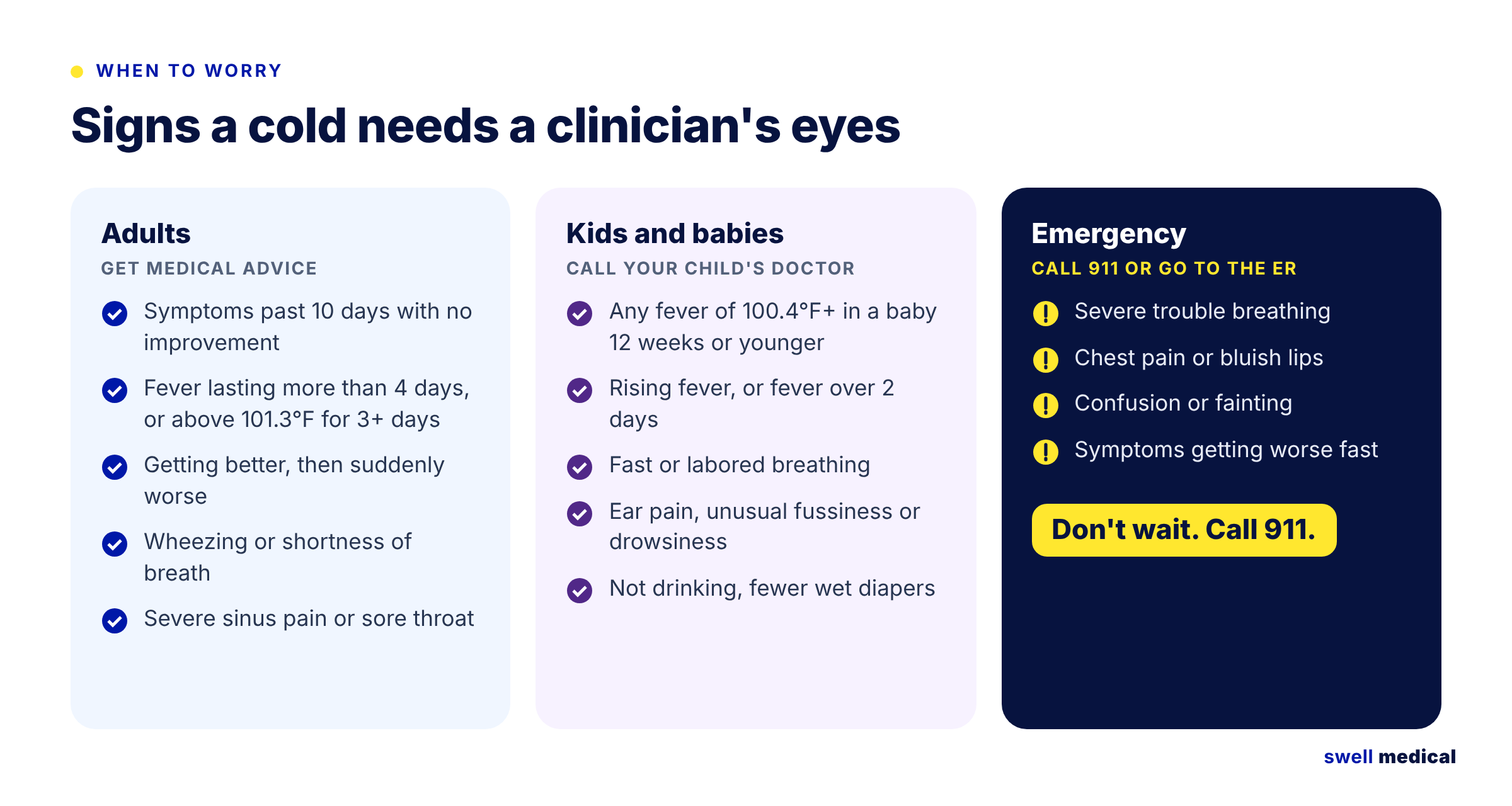
Adults
Get medical advice if you have:
- Symptoms lasting more than 10 days without improving
- A fever lasting longer than 4 days (CDC), or above 101.3°F for more than three days (Mayo Clinic)
- Symptoms that improve and then come back worse, which can point to a sinus infection, bronchitis or pneumonia
- Shortness of breath or wheezing
- Severe sinus pain, a pounding head or an intense sore throat
- Signs of dehydration, or a chronic condition such as asthma, COPD or heart failure getting worse
Children and babies
Call your child’s doctor if you notice:
- Any fever of 100.4°F or higher in a baby 12 weeks old or younger. Get care right away.
- A rising fever, or fever lasting more than two days
- Fast or labored breathing, or wheezing
- Ear pain, unusual fussiness or drowsiness
- Refusing to eat or drink, or fewer wet diapers
Call 911 or go to the ER
Don’t wait if you or your child has severe trouble breathing, chest pain, bluish lips, confusion, fainting or symptoms that are getting worse fast.
Talk to a clinician tonight, not next week
Most colds can be managed at home with rest, fluids and patience. The hard part is knowing whether yours is one of them, especially at 1 a.m. when your child’s coughing suddenly sounds different.
That’s what Swell’s RapidResponse care is for. Describe your cold symptoms in a free screening chat, even if you’re not sure they’re worth a visit. A licensed clinician reviews them and tells you plainly whether it can be handled online, whether you need a test, or whether you should be seen in person.
If a visit makes sense, it’s $45 by secure chat or video, available 24/7. See how it works, or start with your symptoms now.
Questions people ask about how long a cold lasts
What are the 5 stages of a cold?
Some guides split the common cold into five stages: incubation, early symptoms, peak, decline and recovery. Others use three or four. The labels matter less than the pattern. Symptoms build over 2 to 3 days, plateau for a few days, then fade over the second week, with coughing often trailing behind.
Do colds go away in 3 days?
Some mild colds have symptoms that ease in about three days. Most take longer, though. Expect 7 to 10 days for a typical cold, and up to three weeks for a lingering cough to fully settle. Feeling better by day three is a bonus, not the rule.
Can a cold last 2 weeks?
Yes. Nasal symptoms usually clear in about 10 days, but coughing can stay well past two weeks. That’s normal if you’re slowly improving. If you’re getting worse after a week, run a temperature that returns, or have facial pain and pressure, check in with a doctor about a sinus infection or bronchitis.
When can I go back to work with a cold?
You’re most contagious during the first 2 to 3 days of symptoms. Most people can return to work or school once they’ve gone a full day without a raised temperature (and without fever reducers) and feel well enough to get through the day. Keep up hand washing and cover your mouth, since droplets can still spread the virus.
Does green mucus mean I need antibiotics?
No. Mucus often turns yellow or green a few days into a common cold as your immune system fights the virus. Color alone doesn’t mean a bacterial infection, and antibiotics won’t shorten a viral cold. What matters more is the timeline: symptoms past 10 days, or ones that improve and then get worse.
What are the last stages of a bad cold?
In the final stage, your nose clears, energy returns and a dry or slightly productive cough lingers. This post-viral cough can last two to three weeks as your airways heal. It should get milder each week. Coughing with a high temperature, chest pain or shortness of breath needs a doctor’s look.
Trusted references
Public-health, research, and medical-society resources related to this guide.